What a Septic Tank Inspection Covers: A Home Sale Guide for Miami Buyers and Sellers
If your closing depends on a septic tank inspection and you have no idea what the inspector is going to do out there, this guide is for you. Maybe your home inspection flagged the septic system. Maybe the contract requires a septic certification before anyone signs. Either way, the clock is ticking, everyone in the deal is pushing you to move fast, and you need to know three things: what gets checked, how long it takes, and what happens if something fails. This walks through all of it in plain English, the way a local Miami-area septic crew would explain it standing in your yard.
Why a Septic Inspection Comes Up During a Home Sale
A septic system is one of the most expensive parts of a property, and it lives underground where nobody can see it. Buyers, lenders, and sometimes insurers want proof that the system works before money changes hands. That is what a septic inspection for a home sale provides: documentation that the tank, the pipes, and the leach field are doing their jobs.
Here is the part that catches people off guard. A general home inspector usually does not open the septic tank. They flush a few toilets, look for soggy ground, and write "recommend septic evaluation by a qualified professional" in the report. That one line is often what sends buyers and sellers searching for septic tank inspection near me with a closing date three weeks out.
The good news is that a proper inspection is a routine job for a local septic company. It is not a mystery, and it does not have to blow up your timeline. Knowing what the inspector looks for helps you schedule the right service the first time and read the report without panic.
What Gets Checked During a Septic Tank Inspection
A septic inspector checks the tank's structural condition, the inlet and outlet baffles, the liquid level, signs of past leaks or backups, and how well the leach field accepts water. A thorough inspection includes pumping the tank so the technician can see and photograph the interior walls. The goal is simple: confirm waste flows in, separates, and drains out the way it should.
To understand the checklist, it helps to know how the system works. According to the U.S. Environmental Protection Agency, a conventional septic system has two main components: the septic tank and the drain field. The tank holds wastewater long enough for solids to settle, and the drain field, often called a leach field, disperses the clarified liquid into the soil.
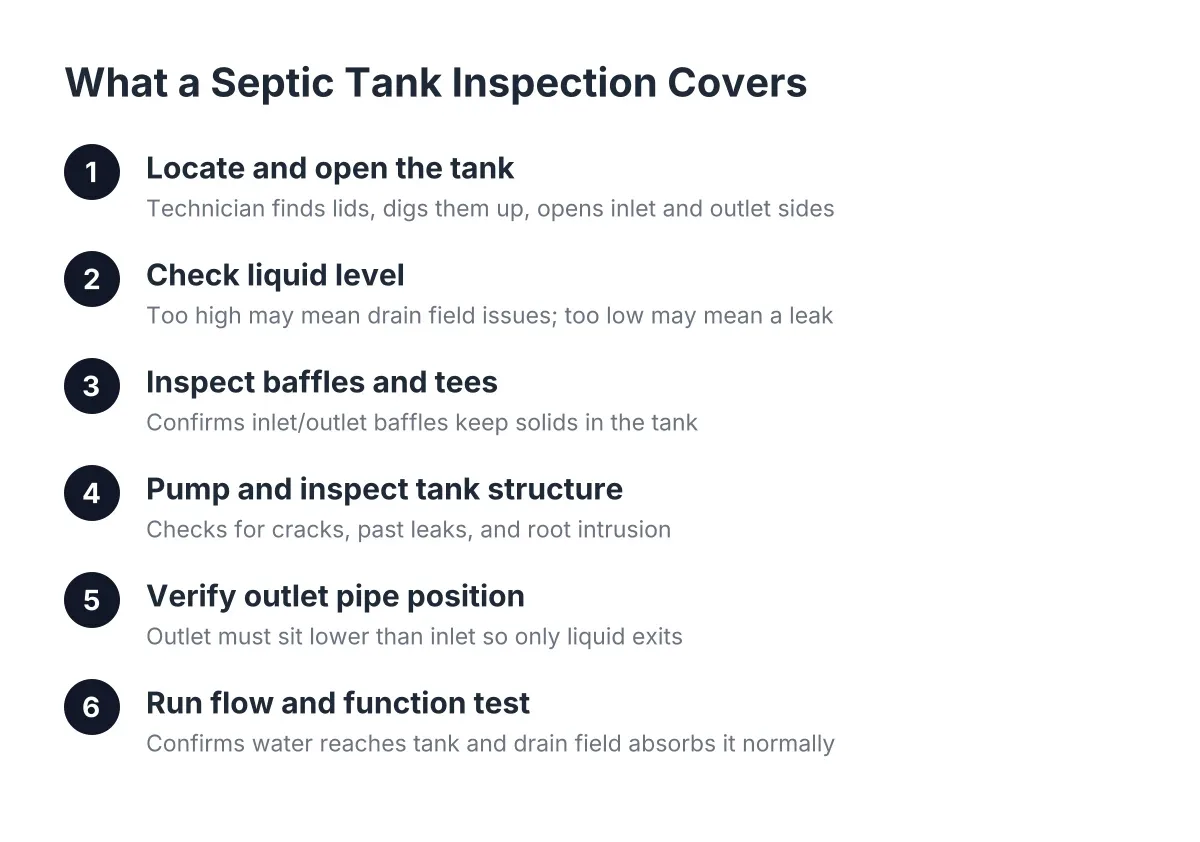
With that picture in mind, here is what a typical septic tank inspection covers:
- Locating and opening the tank. The technician finds the lids, digs them up if needed, and opens both the inlet and outlet sides. Some properties have an inspection port or riser that makes this faster.
- Liquid level check. The level tells a story. Too high can mean the drain field is not accepting water. Too low can mean the tank is leaking.
- Baffle and tee condition. The inlet and outlet baffles keep solids in the tank and out of the leach field. Clogged or broken tees are a common flag on inspection reports.
- Tank structure. After a pump out, the technician looks for cracks in the walls, signs the tank has ever leaked, and roots pushing in near or through the tank.
- Outlet pipe position. According to University of Nebraska-Lincoln Extension, the outlet pipe must sit lower than the inlet, since solids float and only liquid should exit toward the drain field. An inspector confirms this is still true.
- Flow and function test. Water runs from the house to confirm it reaches the tank, and the technician watches whether the drain field takes water at a normal rate.
- Surface conditions. Soggy spots, sewage odors, or unusually green grass over the leach field all point to trouble below.
Beyond the physical checks, a good local company gathers background first: the age of the house, when the tank was last pumped, any repair history, and whether the property sits on high ground or low ground near water. In the Miami area, where the water table runs high, that last question matters more than most buyers realize.
Does the Tank Need to Be Pumped Before Selling the House?
In most cases, yes, the septic tank should be pumped as part of a pre-sale inspection. A full tank hides everything the inspector needs to see. Pumping the tank first gives a clear view of the walls, baffles, and floor, so the technician can assess and photograph the true condition instead of guessing through murky water.
This is why septic tank inspection and pumping are usually booked together for real estate deals. It saves a second trip, and it produces a stronger report. A report that says "tank pumped, interior photographed, walls sound, baffles intact" carries far more weight at the closing table than one based on a dipstick reading.
There is also a maintenance argument for the buyer. The EPA recommends inspecting the entire septic system every 1 to 3 years and pumping the tank every 3 to 5 years. If the sellers cannot say when the tank was last pumped, a pump out at sale time gives the new owners a clean starting point for that schedule.
One honest caveat: pumping right before a flow test can mask a struggling drain field, because an empty tank absorbs a lot of water before anything reaches the field. An experienced technician accounts for this by checking the field's condition directly, not just running water into a freshly emptied tank. This is one reason to hire a septic company for the job rather than relying on a visual-only check.
How Long Does a Septic Inspection Take?
A septic inspection typically takes one to three hours on site, depending on how easy the tank is to find and whether pumping is included. Locating buried lids adds time; a tank with accessible risers goes faster. The written report usually follows within a few days, which matters when your closing date is fixed.
For the real estate timeline, plan backward from closing. Suppose a buyer in the Miami area has a 30-day contract with a 10-day inspection period. In that scenario, a workable sequence looks like this:
- Days 1 to 2: Call a local septic company, explain it is for a home sale, and ask what documentation their report includes. Have the property address and any records of past pumping ready.
- Days 3 to 7: Inspection and pump out happen on site. Be there if you can. Watching the technician open the tank and hearing the explanation firsthand beats reading a report cold.
- Days 7 to 10: Report arrives. Share it with your agent and the other party. If issues turned up, get a repair estimate immediately so negotiations can start inside the inspection window.
Sellers can compress this even further by scheduling the septic tank inspection before listing. A clean report in hand removes one of the most common reasons deals stall, and it signals to buyers that you have nothing to hide underground.
Property managers face a version of the same crunch. Say an HOA board is preparing several septic-served units for sale or refinancing across a portfolio. Scheduling inspections and pump outs across all of them with one local vendor, on one documented service history, is faster than sourcing a new septic cleaner near me for each address. Documented reports also help with insurance and liability questions later.
Reading the Report: What a Flagged Issue Actually Means
An inspection report is not a pass or fail stamp. It is a condition summary. A standard report documents the property address, date of service, work performed, tank material such as concrete, whether problems were found, whether the tank has ever run full, the condition of the tees and baffles, and overall tank integrity.
Therefore, when something gets flagged, the first question is not "is the deal dead" but "which category is this in." Flagged issues generally fall into three buckets:
Maintenance items. An overdue pump out, a dirty septic tank filter, or a clogged outlet tee. These are the cheapest and fastest fixes. Septic tank filter cleaning takes minutes once the tank is open, and a routine pump out is a standard service call. Most deals absorb these without drama.
Component repairs. A broken baffle, a damaged inlet pipe, or a cracked lid. These cost more than maintenance but far less than a new system, and a local crew can usually handle them quickly. Sometimes a problem hidden under years of grime only shows once the area around the tank is cleaned off, which is another argument for a hands-on inspection over a surface glance.
System-level problems. A leach field that will not accept water, a tank that has leaked, or heavy root intrusion through the tank walls. These are the serious ones. Leach field repair or replacement is the expense everyone fears, and it is where negotiation between buyer and seller does the heavy lifting.
For scale, the EPA notes that regular maintenance runs about $250 to $500 every three to five years, while repairing or replacing a failed system can cost between $5,000 and $15,000. That gap is exactly why buyers insist on a real inspection and why sellers benefit from fixing small problems before they become closing-week emergencies.
If the report flags something you do not understand, ask the technician to explain it in plain terms before you forward it to anyone. A knowledgeable local company can tell you whether "outlet baffle deteriorated" means a modest repair or a warning sign about the field. Guessing, or letting a nervous agent guess for you, is how minor findings turn into dead deals.
When a Septic Tank Inspection Fails: Your Options
A failed inspection does not automatically kill a sale. It changes the negotiation. Depending on the finding and your contract, you generally have four paths: the seller repairs before closing, the buyer takes a credit and handles it after, the price adjusts, or the parties walk away. Most flagged issues resolve through the first two.
First, get a second set of eyes if the finding is major. A leach field verdict based on a single soggy afternoon after heavy Miami rain deserves confirmation before anyone spends five figures. A follow-up flow and function test on a dry day can tell a different story.
Next, get a written repair estimate fast. Lenders and title companies want numbers, not adjectives. An estimate for leach field repair or a baffle replacement turns an alarming report line into a solvable math problem the two sides can split.
In addition, know what falls outside a private inspection's scope. Repairs or replacements of septic systems in Florida involve the local health department, and permits or official evaluations may be required depending on the work. Your septic company can tell you when a job crosses that line. This matters beyond the transaction too; according to the Florida Department of Environmental Protection, well-maintained septic systems help protect the groundwater that supplies 90% of Florida's drinking water.
One limitation worth naming: no inspection can see everything. Pipes under slabs, the deep layers of a drain field, and future usage patterns are all outside what any technician can fully verify. A thorough septic system inspection reduces risk substantially; it cannot eliminate it. For anything structural or field-related, rely on a professional's judgment on site rather than a report line read in isolation.
Setting Up the New Owner for Success After Closing
Once the deal closes, the septic system becomes the new owner's responsibility, and the inspection report becomes the baseline record. Keep it. Future buyers, insurers, and service companies will all want to know the tank's material, its condition at the last opening, and the pumping date.
From there, the maintenance rhythm is straightforward. University of Florida IFAS advises pumping tanks every three to five years to keep them in working order, and notes that with proper maintenance a septic tank can last up to 30 years. Put the next pump out on the calendar the week you move in, before life buries the reminder.
For property managers absorbing a septic-served building into a portfolio, this is the moment to fold the property into a scheduled pumping and inspection cycle with a single local vendor. One service history across every septic address means the next pre-sale inspection, tenant complaint, or grease trap clean out at a mixed-use unit is a phone call, not a scramble.
Finally, remember what the inspection was really for. It was never about paperwork. It was about knowing, before the biggest purchase of your life closed, that the system under the yard actually works. A clear septic tank inspection gives you that answer, and in a deal where everything else feels rushed and uncertain, that is one worry you get to cross off the list.
If you need septic tank pumping, Miami Septic Tanks can help.
Prefer to talk it through? Call (786) 756-8032 — a quick call is usually the fastest way to get a straight answer for your situation.