Septic Service Costs — Complete Guide
septic service costs — The Complete Guide
Septic service costs confuse more homeowners than almost any other home maintenance expense. Prices vary between companies, quotes rarely itemize the work, and national call centers often route your call to someone who has never seen a Miami septic system. Understanding septic pumping vs cleaning is the first step to making sense of any quote you receive. This guide breaks down what you should expect to pay for pumping, cleaning, inspections, filter service, grease trap clean outs, and leach field repair in the Miami area. You will also learn which factors drive prices up, how to compare quotes fairly, and how to spot the upsells that inflate your bill. By the end, you will know enough to budget with confidence and hire without second-guessing.
What You'll Find in This Guide
Coming soon — we're building out this topic cluster.
What Drives Septic Service Costs in Miami
Every septic quote comes down to a handful of variables. Once you understand them, pricing stops feeling like a guessing game and starts looking predictable.
Tank size matters most. A 750-gallon tank takes less time and hauls less waste than a 1,500-gallon tank, so it costs less to pump. Most Miami homes fall somewhere between those two sizes. However, many homeowners have no idea what size tank they own, and that uncertainty gives vague quotes room to hide extra charges. Ask your provider to confirm the tank size on site and note it on your invoice.
Access is the second big factor. If your tank lid sits under two feet of soil, someone has to dig before pumping can start, and that labor adds to the bill. Similarly, a tank located far from where the truck can park may require extra hose runs, and some companies charge for that. Installing riser lids after your first pump out usually pays for itself by eliminating dig fees on every future visit.
Condition drives the rest, which is where septic pumping vs cleaning becomes a real pricing question rather than a technicality. A tank pumped on schedule empties quickly. In contrast, a neglected tank packed with compacted sludge takes longer and may need a full cleaning rather than a standard pump out. Pumping removes liquids and floating waste, while cleaning goes further and scrapes out the hardened solids clinging to the tank walls and floor. Because cleaning takes more time and effort, it costs more. Knowing which service you actually need prevents you from paying for one when the other would do.
Why Regular Service Costs Less Over Time
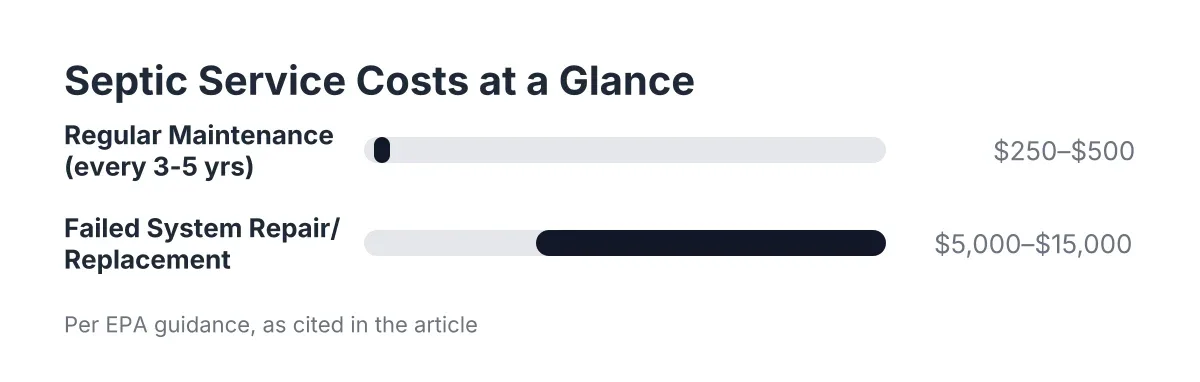
Here is the number that should anchor every budgeting decision. According to the U.S. Environmental Protection Agency, regular septic maintenance runs $250 to $500 every three to five years, while repairing or replacing a failed system can cost $5,000 to $15,000. To put it simply, the cheapest septic strategy is a consistent one. Skipping a pump out to save a few hundred dollars can push solids into your drain field, and drain field damage sits at the expensive end of every septic price list.
This math matters in South Florida more than most places. Miami Waterkeeper reports approximately 120,000 septic systems in Miami-Dade County alone, and roughly 2,600,000 septic tanks across Florida. As a result, local demand for service is steady, and reputable companies have no reason to lowball a quote and make it up in surprise fees. If a price sounds too good to be true, it usually funds itself somewhere on the final invoice.
Septic Pumping vs Cleaning: Comparing Costs Across Services
Not all septic services cost the same, and they should not. Each one involves different equipment, time, and disposal requirements. With this in mind, here is how the core services stack up against each other, starting with the comparison that confuses homeowners most: septic pumping vs cleaning.
Septic tank pumping is the baseline service and typically the least expensive. The truck arrives, the technician locates and opens the tank, pumps out the contents, and hauls the waste to a licensed disposal facility. For most homes, this is the service you schedule every three to five years. That interval comes straight from EPA guidance, which recommends pumping every 3 to 5 years and inspecting the full system every 1 to 3 years.
Septic tank cleaning costs more than pumping because it includes pumping plus removal of compacted sludge. For example, if your tank has gone seven or eight years without service, expect a cleaning quote rather than a pumping quote. The difference is legitimate, but a company should explain why you need cleaning instead of pumping, and they should show you the tank condition that justifies it.
Inspection and Filter Service Pricing
A septic system inspection costs less than pumping in most cases, since no waste hauling is involved. During an inspection, a technician checks tank levels, baffles, the outlet filter, and signs of drain field trouble. Beyond that, inspections make sense at two moments: on the EPA's recommended 1 to 3 year cycle, and before you buy a home with a septic system. A few hundred dollars of inspection can reveal thousands of dollars of hidden problems before you sign anything.
Septic tank filter cleaning is one of the smallest line items in septic care, yet skipping it causes outsized damage. The effluent filter catches solids before they reach your drain field, and when it clogs, wastewater backs up into your home or yard. In practice, many companies clean the filter during a routine pump out for little or no added cost. Ask whether filter cleaning is included in your pumping quote. If it costs extra, it should cost a little extra, not a lot.
Grease trap cleaning follows its own pricing logic because it serves restaurants and commercial kitchens. Trap size, grease volume, and cleaning frequency drive the price. Consequently, a small under-sink trap costs far less to service than a large in-ground interceptor. Property managers should build grease trap clean outs into a recurring schedule, since Miami-Dade requirements and kitchen volume both demand consistency.
Repair Costs and How to Avoid Being Overcharged
Repairs sit at the top of the septic price range, and this is where hidden cost anxiety is most justified. Fortunately, a few habits protect you from paying more than the work is worth.
Leach field repair is the big-ticket item. The leach field, also called the drain field, disperses treated wastewater into the soil. When it fails, symptoms show up as soggy patches, sewage odors, or slow drains throughout the house. Repair costs depend on the failure type. For instance, a crushed distribution pipe costs far less to fix than a saturated field that needs partial or full replacement. Because the range is so wide, never accept a leach field quote without a written diagnosis explaining what failed and why.
Sewer tank service and structural tank repairs fall in the middle of the price range. Cracked lids, broken baffles, and damaged inlet pipes are common repairs. Individually, these fixes are affordable. However, they become expensive when a company bundles them into a vague "system restoration" quote without itemizing each part.
Red Flags That Signal Overcharging
Watch for these patterns when you collect quotes. First, a price quoted over the phone with no questions about tank size, location, or last service date is a guess, and guesses get revised upward on site. Second, pressure to approve add-on services during the visit deserves skepticism, since a legitimate finding comes with a photo or an invitation to look inside the tank yourself. Third, additive treatments pitched as a substitute for pumping do not work. The EPA's maintenance guidance centers on pumping and inspection, not miracle products.
Additionally, be careful with "cheapest septic tank pumping" offers you find online. Some national aggregator sites advertise low teaser rates, then route your call to an out-of-state dispatcher who subcontracts the job. As a result, the truck that shows up may charge trip fees, dig fees, and disposal fees the ad never mentioned. A local company with a local reputation has more incentive to quote honestly, because you can tell your neighbors either way.
To protect yourself, get every quote in writing with each service itemized. Confirm what the price includes: digging, filter cleaning, disposal, and any inspection notes. Then compare at least two quotes on the same scope of work, since identical scopes make the fair price obvious fast.
Budgeting for Septic Service Costs Year Over Year
The smartest way to handle septic service costs is to treat them as a scheduled expense, not an emergency. Nearly 25 percent of U.S. households, more than 26 million homes, rely on septic systems, according to Census Bureau data cited by the EPA. Yet most of those households only think about their tank when something goes wrong. You can do better with a simple plan.
Start by anchoring your budget to the EPA's maintenance cycle: inspect every 1 to 3 years, pump every 3 to 5 years. For a typical Miami home, that means setting aside a modest amount annually so the pump out never strains your finances when it comes due. Spread across five years, even the higher end of routine maintenance costs works out to a small monthly figure. In contrast, an unplanned drain field replacement can wipe out years of savings in one invoice.
Next, adjust the schedule for your household, since more people means more wastewater, and more wastewater fills the tank faster. For example, a family of six may need pumping every two to three years, while a two-person household might stretch to five. A garbage disposal shortens the interval further because it sends extra solids into the tank. Your service provider can recommend a realistic interval after seeing your tank's condition at the first pump out.
How Septic Pumping vs Cleaning Records Save You Money
Finally, keep a service log. Record each pump out date, the tank size, the sludge level the technician observed, and any repairs made. This record does three things for you. It tells the next technician exactly what they are working with, which shortens the visit. It also gives you leverage when comparing quotes, because you can specify the exact scope of work and settle any septic pumping vs cleaning question before the truck arrives. Moreover, a documented history becomes a selling point if you ever list your home, since buyers and inspectors trust proof of maintenance.
Property managers should apply the same logic across every septic-dependent building they oversee. Consequently, a portfolio-wide pumping schedule with one trusted local provider almost always costs less than scattered emergency calls to whoever answers first.
Ready to Get Started?
You now know what fair septic service costs look like, so the next step is getting a real quote for your specific tank. Call us for straightforward, itemized pricing on pumping, cleaning, inspections, filter service, grease trap clean outs, and leach field repair anywhere in the Miami area. No call centers, no vague estimates, just a local team that tells you the price before the truck arrives.