Why Septic Drain Fields Fail and How Timely Repairs Prevent Total Collapse
Your septic drain field is the part of the system nobody sees and nobody thinks about, right up until it stops working. When it fails, the failure does not announce itself politely. It shows up as slow drains during your busiest hour, a sour smell near the back of the property, or soggy ground where the grass grows too green. For a Miami-area restaurant operator, that failure can mean a health inspector's flag, a kitchen backup mid-service, or a shutdown you cannot afford. The good news is that most drain field failures build up slowly, over months or years. Catch the causes early and a repair can stop the slide. Ignore them and you are looking at a full replacement, the single most expensive septic bill there is.
This guide walks through what actually kills a drain field, the warning signs that show up before collapse, what repairs cost in plain numbers, and how to tell whether your field can be fixed or has to be replaced.
What a Septic Drain Field Actually Does
A septic drain field, also called a leach field, is the network of perforated septic drain field pipe or chambers buried in shallow trenches beyond your tank. Wastewater leaves the tank, flows into those trenches, and filters down through gravel and soil. The soil does the final cleaning. Bacteria in the ground break down what is left before the water reaches the groundwater below.
That last part matters more in Florida than almost anywhere else. According to the Florida Department of Environmental Protection, groundwater provides 90% of the state's drinking water, and properly built and maintained septic systems help protect it. Your drain field is not just a convenience. It is the barrier between your kitchen's wastewater and the water everyone drinks.
Here is the key thing to understand: the drain field only works if the soil around it can still absorb water. Everything that causes drain field failure comes down to one problem. Something clogged, compacted, or drowned the soil so water can no longer soak in. Once that happens, wastewater has nowhere to go but up, out, or back into your building.
The Five Causes That Kill a Septic Drain Field
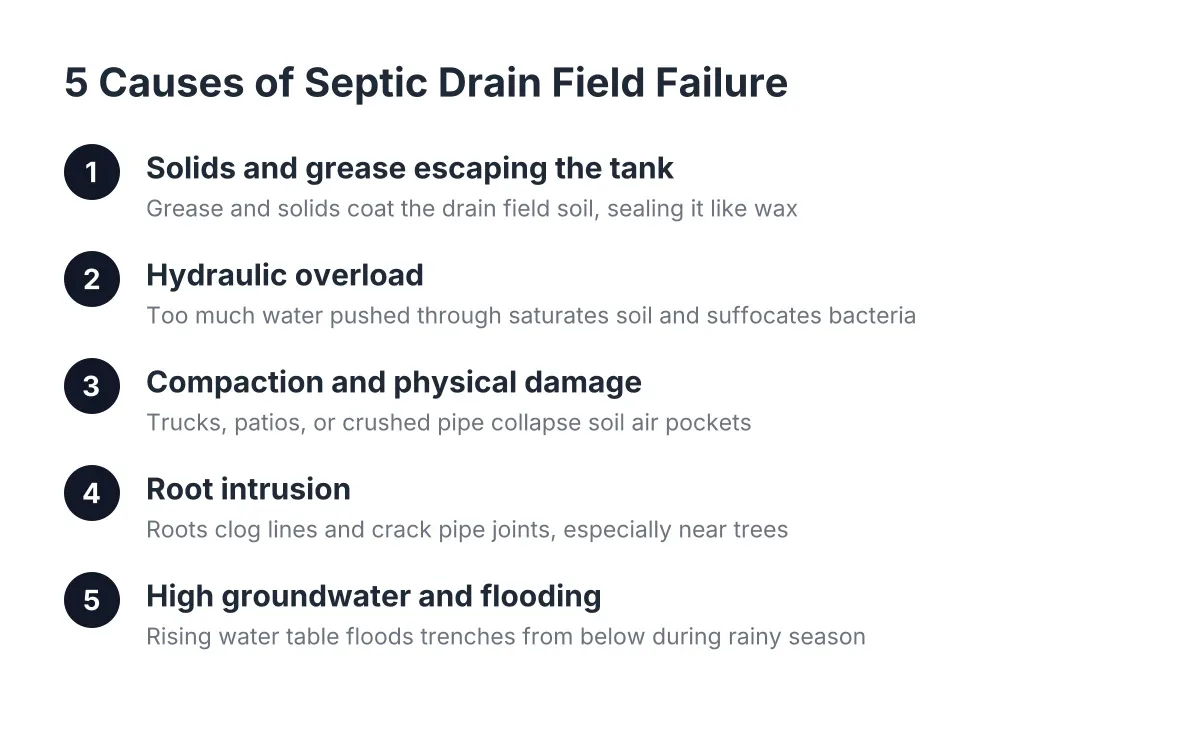
Drain fields rarely die of old age alone. With decent care, University of Florida IFAS notes that septic tanks can last up to 30 years, and a well-treated field can go a similar distance — 20 to 30 years is a reasonable expectation for a leach field with regular maintenance. Most fields that fail early were pushed there by one of five causes.
1. Solids and grease escaping the tank
This is the number one killer, and for restaurants it is the most preventable. Your septic tank is designed to hold solids and floating grease so only liquid moves to the field. When the tank gets too full, or when the grease trap upstream is neglected, solids and fats slip through and coat the drain field soil. Over years of use, a black, tar-like layer of bacteria and solids, called biomat, forms in the soil around the field lines. Some biomat is normal. Too much seals the soil like a layer of wax so water cannot pass. This is the most common cause of a saturated field, and caught early, it is often repairable without full replacement.
For a commercial kitchen, grease is the fast lane to this failure. A grease trap that misses its clean out schedule sends fats, oils, and grease straight toward the tank. From there it is a short trip to the field. Regular septic tank pumping and grease trap cleaning are not maintenance chores. They are the two things standing between your kitchen and a dead field.
2. Hydraulic overload
Every drain field is sized for a certain daily flow. Push more water through than the soil can absorb and the field drowns. For a home, that might be a leaking toilet running all night, a water softener discharging into the system, too many loads of laundry in one day, or roof drains routed toward the field. For a restaurant, it is often a dish pit that runs nonstop, a new fryer line, or an expansion that doubled covers without anyone rethinking the septic system. The field never gets a dry cycle, the soil stays saturated, and the bacteria that clean the water suffocate. Fix the water source and a marginal field can often recover.
3. Compaction and physical damage
Soil needs air pockets to absorb water. Park a delivery truck over the field, pour a patio on top of it, or let the dumpster hauler drive across it every week, and those pockets collapse. Crushed septic drain field pipe is common on commercial lots where nobody marked where the trenches run. Once a line is crushed, the wastewater dumps into one spot instead of spreading across the whole field. Physical damage usually needs excavation, but often only in one section rather than across the whole field.
4. Root intrusion
Tree and shrub roots hunt for water, and a drain field is a buffet. Roots work into pipe joints and chambers, clog the lines, and crack the pipe as they grow. In Miami-area landscaping, ficus and other aggressive species are frequent offenders. A field bordered by mature trees should be inspected more often, not less.
5. High groundwater and flooding
South Florida sits low, and the water table sits high. During heavy rain season, groundwater can rise into the drain field trenches from below. A field that was marginal in the dry months can fail outright in a wet one. This is one cause you cannot pump or clean your way out of; it is a design and siting issue, and it is why professional evaluation matters before you spend money on repairs.
Early Signs Your Septic Drain Field Is Failing
Drain field failure sends warnings before it shuts you down. The trick is knowing the difference between a clogged pipe, which is cheap, and a failing field, which is not. Watch for these:
- Slow drains across the whole building, not just one sink. One slow drain is a plumbing clog. Every drain slow at once points to the tank or the field.
- Sewage odors outside, near the tank or over the field, especially after heavy use.
- Wet, spongy, or mushy ground over the drain field when it has not rained.
- Standing water or gray puddles over the field lines.
- Grass that is greener and taller in stripes over the trenches. The field is feeding the lawn instead of filtering into the soil.
- Gurgling sounds in drains and toilets during or after use.
- Toilets that flush weakly or need two flushes, or water backing up into the tub or shower when the washing machine runs.
- Backups that return shortly after a pump out. If pumping the tank only buys you a few weeks, the water is not leaving the field.
A simple way to check the plumbing side: run water in the lowest fixtures in the building, usually a ground-floor tub, shower, or floor drain, and watch how they behave when other fixtures run. Outside, one South Florida caveat applies: give the yard two or three dry days after a storm before you judge, since summer rain can mimic wet-spot symptoms. If the wet spots stay after the ground around them dries, the field is the likely culprit.
That last sign on the list is the one that separates a field problem from everything else. Suppose a taqueria owner in Little Havana has the tank pumped after a Friday backup. Service runs fine for three weeks, then the floor drain in the dish pit starts gurgling again. The tank is not the problem in that scenario. The field cannot accept the water, so the tank refills faster than it should. If a pump out fixes the problem and it stays fixed, the tank was simply full. If the tank fills back up within days or weeks, the field is not draining — that fast refill is the single most reliable sign of a failing drain field. Pumping again treats the symptom while the field keeps dying underground.
Rule Out the Cheap Fixes Before You Blame the Field
Before you assume the worst, rule out the inexpensive problems. Many "failed field" calls turn out to be a full tank or a clogged outlet filter. Have a local septic service open the tank and check three things:
- The sludge and scum levels, which tell you if the tank is overdue for pumping
- The outlet filter, which can clog and mimic field failure until a septic tank filter cleaning clears it
- The baffles, which keep solids out of the field when they are intact
For a restaurant kitchen with slow, smelly drains during a dinner rush, the smart sequence is: grease trap clean out first, then a septic tank pump out and filter check, then a field evaluation only if the tank refills fast. That order fixes the cheap problems first and keeps the kitchen open while you sort out the rest. A homeowner facing the same symptoms follows the same logic, just without the dinner rush.
Can a Septic Drain Field Be Fixed Without Replacement?
Yes, a septic drain field can often be repaired without full replacement if the failure is caught early and the soil itself is still viable. Repairs work when the problem is a clogged line, a crushed section of pipe, root intrusion, or a neglected tank pushing solids downstream. Replacement becomes necessary when the soil is saturated with grease or biomat and can no longer absorb water at all.
The honest answer any good technician will give you starts with a septic system inspection. A camera in the lines, a check of the tank's solids level, and a look at how water moves through the field tell you which side of the line you are on. Common repair paths, roughly from least to most invasive:
- Pump out and rest. If overload caused the failure, pumping the tank and cutting water use can let a saturated field dry out and recover. This works only when the soil is not sealed.
- Line jetting and root removal. Clearing clogged distribution lines and cutting out roots restores flow when the pipes, not the soil, are the problem.
- Sectional pipe repair. Digging up and replacing a crushed or broken run of septic drain field pipe fixes physical damage without touching the rest of the field.
- Field aeration or fracturing. Some contractors mechanically fracture compacted soil to restore absorption. Results vary with soil type, and it is not a fit for every site.
- Adding trenches or chambers. If part of the field is dead but you have space, extending the field with new septic drain field chambers can add capacity without abandoning the whole system.
There is a real limitation here worth naming. Once grease and solids have sealed the soil across the field, no amount of cleaning brings it back. A septic drain field cleaner product poured down the drain will not dissolve years of buildup, whatever the label promises. And one honest trade-off on rejuvenation methods: jetting and fracturing buy time, sometimes years, but they do not make an old field new. If your field is past 25 years old and failing in multiple spots, putting that money toward replacement is usually the smarter call, and a company that tells you otherwise is selling you a delay, not a fix.
What Leach Field Repair Costs in Plain Numbers
Nobody should have to book a site visit just to learn whether they are facing a hundred-dollar fix or a five-figure project. So here are illustrative ranges, framed as estimates, for what these jobs tend to run as of 2026. Your actual number depends on soil, access, permitting, and how far the damage has spread, so treat these as planning figures, not quotes.
- Septic system inspection with camera work: an estimated few hundred dollars, often the best money in this whole list.
- Filter cleaning and baffle repair: low hundreds, and it fixes the problem when solids were escaping the tank.
- Line jetting or root removal: typically in the high hundreds to low thousands.
- Sectional pipe repair: often a few thousand dollars, depending on depth and access.
- Partial field repair or field extension: commonly several thousand dollars.
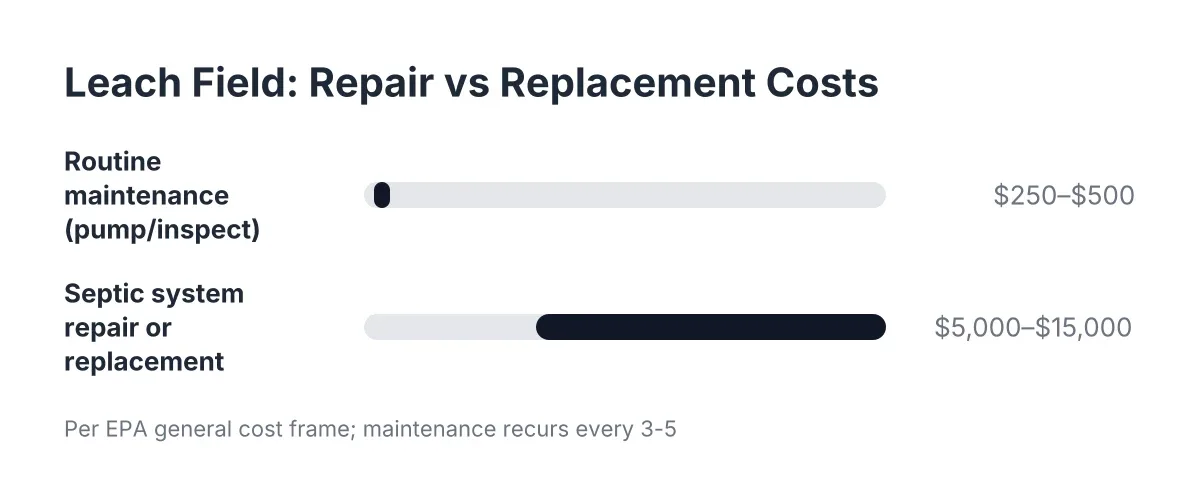
- Full septic drain field replacement: this is where costs climb steeply. According to the U.S. Environmental Protection Agency, repairing or replacing a malfunctioning system can cost between $5,000 and $15,000, while regular maintenance runs $250 to $500 every three to five years. In Miami, high groundwater can require a mounded system, which pushes replacement toward the top of that range.
Read that EPA comparison twice, because it is the whole argument of this article. Routine septic tank pumping and inspection cost a fraction of what a failed field costs. Leach field replacement cost sits at the top of the septic repair scale, and septic tank repair cost for smaller fixes sits near the bottom. Every dollar you spend on maintenance is a bet against the big number.
For a restaurant, the replacement figure is only half the pain. A septic drain field replacement means excavation on your property, sometimes across your parking area, over multiple days. If the system cannot handle wastewater during the work, you may be running on pump outs or closed entirely. The downtime often hurts more than the invoice.
Why Restaurants Hit Drain Field Failure Faster Than Homes
A house sends the drain field laundry water, showers, and toilets. A restaurant sends it a fundamentally harder load. Fats, oils, and grease from the kitchen; high water volume from the dish line; food solids from prep sinks; and hot water that keeps grease liquid until it reaches the cool tank and hardens. That is why counties put grease trap requirements on food service in the first place.
Therefore, the maintenance math is different for a commercial kitchen. University of Florida IFAS recommends pumping tanks every three to five years for proper working order, and the U.S. Environmental Protection Agency recommends inspecting the entire septic system every 1 to 3 years. Those intervals assume household loads. A busy kitchen on septic usually needs the tank checked and pumped far more often, and the grease trap cleaned on the schedule your county sets, not the schedule that feels affordable this month.
For example, say a Coral Gables cafe stretches its grease trap clean out from quarterly to twice a year to save money. The trap overfills, grease rides through to the septic tank, and within two years the field starts showing wet spots behind the building. In that hypothetical, the money saved on skipped cleanings is a rounding error next to the leach field repair the operator now faces, plus the inspection risk of a smelly, failing system out back.
One more factor works against you quietly. University of Florida IFAS notes that a conventional septic tank removes only about 30 percent of the nitrogen flowing into it, so even a healthy system loads the surrounding soil over time. Add grease and overload on top of that baseline, and the field's working life shrinks fast.
What to Do the Moment You Spot Failure Signs
If you spotted one or more of the warning signs above, take three actions today. First, cut water use hard: shorter showers, spread out laundry, fix running toilets. Second, keep everyone and every vehicle off the wet area of the yard, since surfacing wastewater is a health hazard. Third, schedule a septic tank pumping and inspection with a local Miami-area service so you know whether you are facing a filter cleaning, a partial repair, or a replacement.
Wet spots, odors, and backups never fix themselves. But they also do not automatically mean a five-figure bill. Most of the time, the earlier you act on the warning signs, the more options you have, and the cheaper the fix turns out to be.
How to Protect Your Drain Field Starting This Week
You cannot control the water table or the age of your system. You can control the load you send downstream. These habits cost little and buy years:
- Keep the grease trap on schedule. For a food service operation, this is the single highest-impact habit. A full trap is a direct pipeline of grease to your field.
- Pump the septic tank before it is overdue, not after a backup. If you do not know when it was last pumped, that is your answer.
- Clean the septic tank filter. Septic tank filter cleaning is a small job that catches solids before they reach the field. A clogged filter backs up the building; a missing one sacrifices the field.
- Get the field mapped and keep weight off it. No dumpsters, no delivery trucks, no paving over the trenches.
- Fix leaks fast. A running toilet or dripping dish sprayer adds hundreds of gallons of load the field never gets a break from.
- Book a septic system inspection on a calendar cycle, not a crisis cycle. Finding a clogged line this year beats finding a dead field next year.
None of this is complicated. It is the same logic as changing the oil in the delivery van. The field fails when nobody is watching it, and it survives when someone local checks it on schedule.
When to Call a Local Septic Company, Not a Call Center
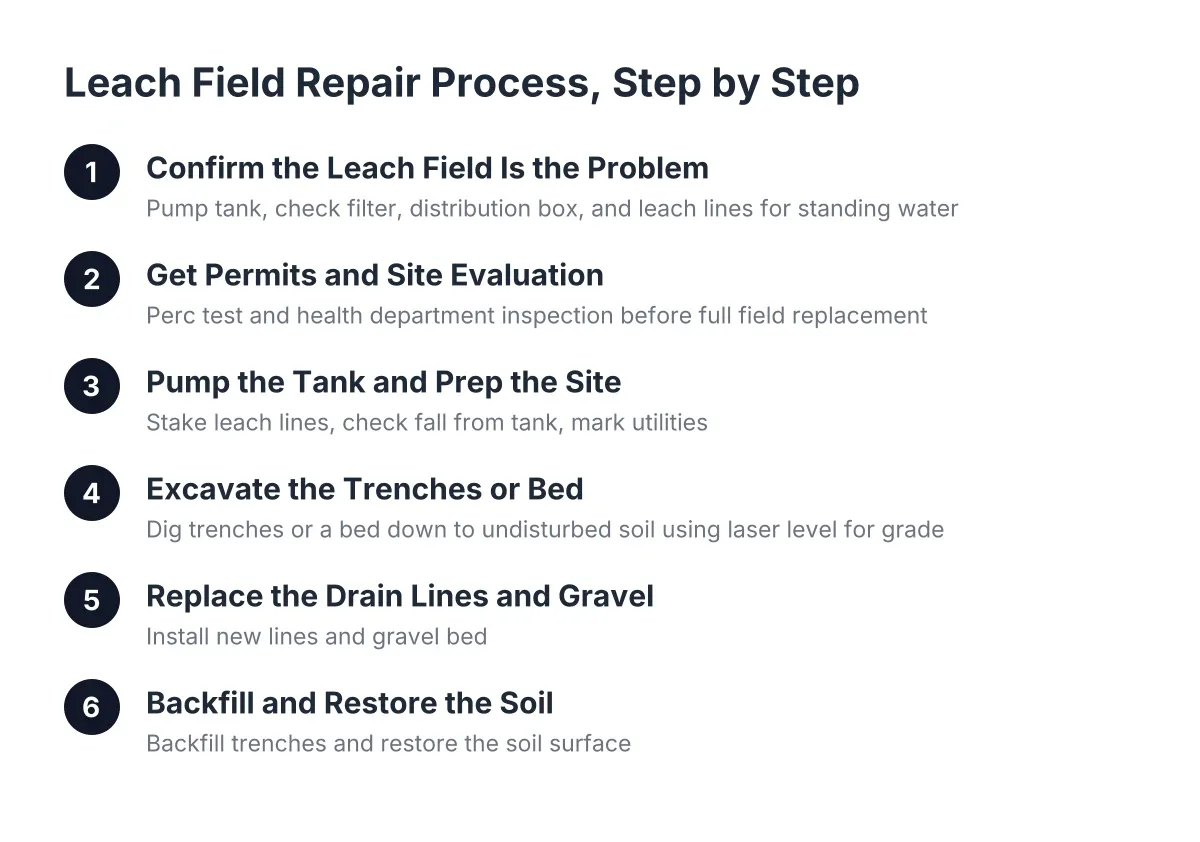
Drain field diagnosis is not a phone-quote job. Soil conditions in the Miami area, the water table on your specific lot, and county permitting all shape what repair makes sense. Field work in South Florida almost always involves the county health department, soil evaluation, and setback rules near wells and waterways, so this is not a do-it-yourself project, and a wrong guess costs real money. A national aggregator that routes your call out of state cannot see your yard, and a rushed quote over the phone is a guess dressed up as an answer. What you want is a local crew that will open the tank, run a camera, and tell you plainly whether you are facing a repair or a replacement, with the reasoning to back it up.
That is also your protection against the fear-pricing this repair is famous for. When someone can explain which of the five failure causes hit your field and show you the evidence, the number they quote has a reason behind it. When someone quotes a full septic drain field replacement without an inspection, ask more questions.
Your drain field will not last forever. However, the gap between a field that dies at year twelve and one that works past year twenty-five is not luck. It is grease traps cleaned on time, tanks pumped before they overflow, filters checked, and problems caught while they are still repairs instead of replacements. The most expensive septic bill is the one you could have made small two years earlier.
If you need septic tank pumping, Miami Septic Tanks can help.
Prefer to talk it through? Call (786) 756-8032 — a quick call is usually the fastest way to get a straight answer for your situation.