Septic Filter Cleaning Step by Step: When, Why, and How Often in Miami
Most articles about septic maintenance talk about pumping and stop there. The septic filter gets skipped, even though a clogged one is behind a lot of slow drains and backups. This guide walks through septic filter cleaning step by step: how to tell if your system has a filter, when it needs attention, and how often to clean it. If you are buying or selling a Miami-area home with a septic system, or you run a restaurant that depends on one, this small part deserves a spot on your checklist.
What a Septic Tank Filter Is and Why It Clogs
A septic tank filter, often called an effluent filter, is a plastic cartridge that sits in the outlet of your tank. Its job is simple: catch solids before they leave the tank and reach your leach field. According to the U.S. Environmental Protection Agency, a typical residential septic system has two main parts, a tank that clarifies wastewater and a drain field that disperses the liquid into the ground. The filter protects that second part.
Inside the tank, solids sink to the bottom as sludge while grease and scum float to the top, according to the U.S. Environmental Protection Agency. The filter catches whatever tries to slip out with the water in between. Over time, it fills with gunk. When it clogs, water backs up into the tank, then into your drains, and eventually into your house.
Not every system has one. Newer tanks in the Miami area usually do; older tanks may only have a baffle at the outlet. If you are mid-purchase on a home and the seller cannot tell you, a septic system inspection will answer the question fast, and it is worth knowing before closing.
Here is why the filter matters more than its size suggests. Solids that escape the tank end up in the leach field, where they clog the soil. Leach field repair costs far more than any routine service. The Florida Department of Environmental Protection notes that well-maintained septic systems help protect Florida's groundwater, which supplies 90% of the state's drinking water. In Miami, with our high water table, keeping solids out of the ground matters.
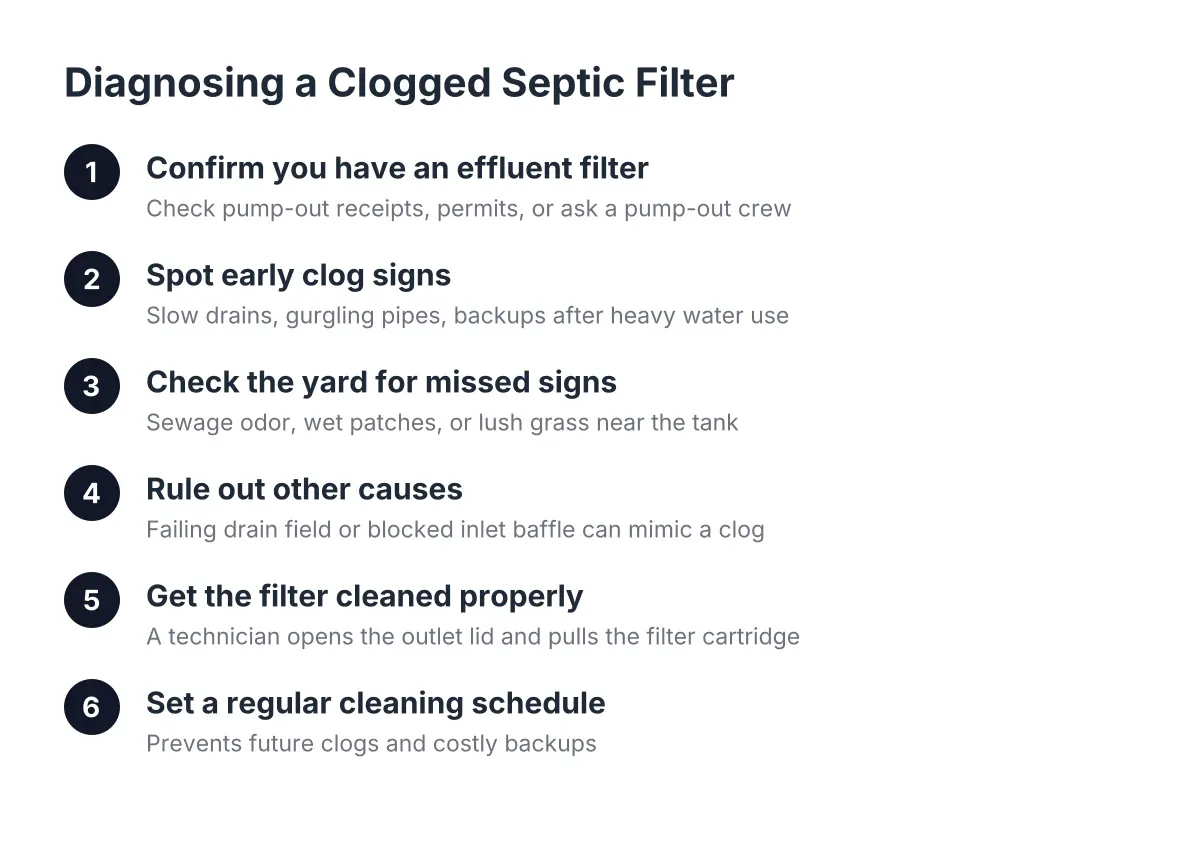
Step 1: Confirm Your System Has a Filter
First, find your tank. Look for the lids in the yard, usually two green or black covers, or check the property's septic permit for a site drawing. The filter sits in the outlet baffle, the side of the tank closest to the leach field. If you see a plastic handle sticking up inside the outlet tee, that is the filter.
If the lids are buried, which is common on older Miami properties, do not start digging blind. A local septic service can locate the tank, expose the lids, and confirm whether a filter is installed. Home buyers should ask for this during the inspection period, not after closing.
Step 2: Watch for the Signs a Septic Filter Is Clogged
A clogged septic filter announces itself before a full backup. Catch it early and the fix is a routine cleaning; miss it and you may be dealing with sewage in the shower drain on a Saturday night.
Watch for these warning signs:
- Drains throughout the house run slow at the same time, not just one fixture
- Gurgling sounds from toilets or drains after you run water
- Sewage odor near the tank lids or inside the house
- Wet or soggy ground over the tank, even in dry weather
- Water backing up into the lowest drain in the house
One slow drain usually means a plumbing clog. Every drain slow at once points to the septic system, and the filter is one of the first things a technician checks. For restaurant operators, the same logic applies to the grease trap; a trap overdue for a grease trap clean out produces the same slow-drain, bad-odor pattern in a commercial kitchen.
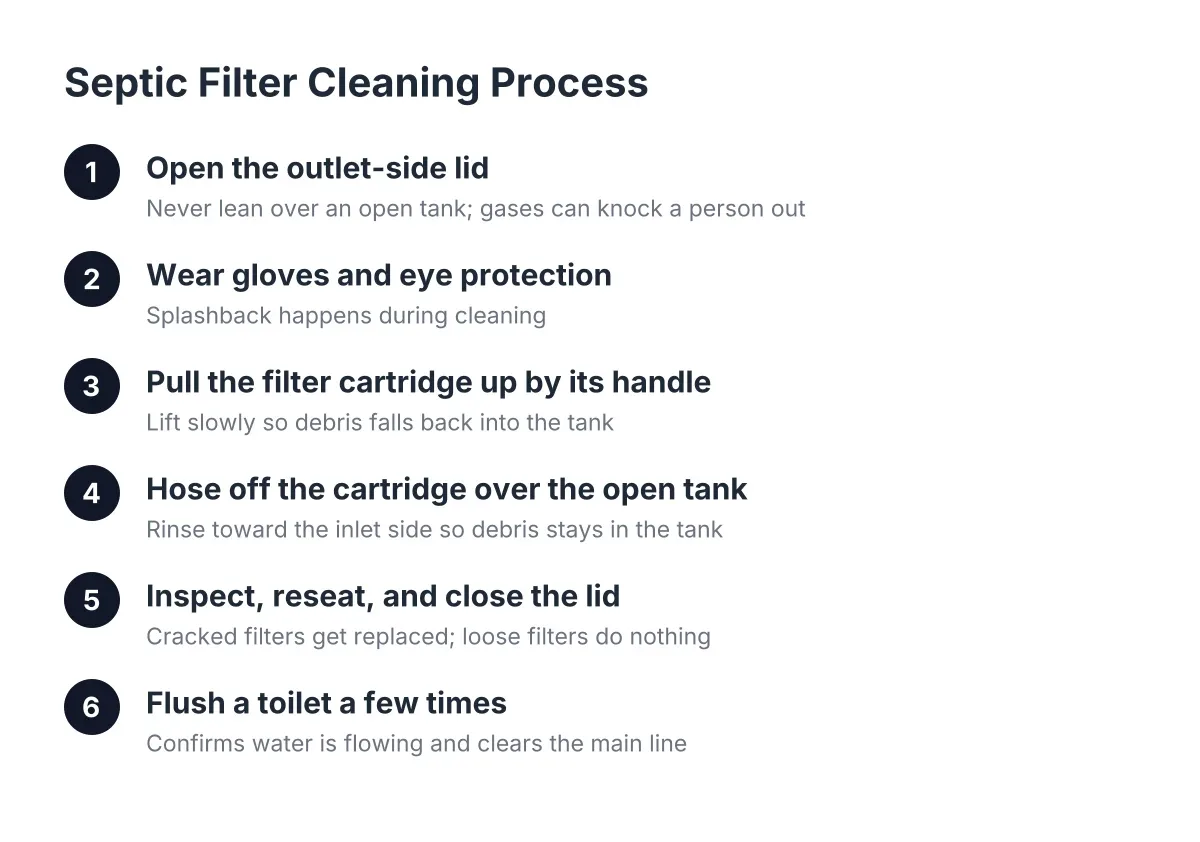
Step 3: Follow the Septic Filter Cleaning Process
Cleaning a septic tank effluent filter is not complicated, but it is messy and it involves an open tank of raw sewage. Here is how the job goes, whether you do it or watch a pro do it.
- Open the outlet-side lid. Never lean over an open tank or let anyone climb in; the gases inside can knock a person out in seconds.
- Wear gloves and eye protection. Splashback happens.
- Pull the filter cartridge straight up by its handle. Lift slowly so debris falls back into the tank, not into the outlet pipe.
- Hose the cartridge off over the open tank, on the inlet side if you can reach it, so everything you rinse off stays in the tank.
- Inspect the cartridge for cracks or broken vanes. A damaged filter gets replaced, not reinstalled.
- Seat the filter back in its housing until it locks in place. A loose filter does nothing.
- Close and secure the lid. In a yard where kids or pets play, this step is non-negotiable.
- Flush a toilet a few times. This pushes anything sitting in the main line down into the tank and confirms water is flowing.
The honest trade-off: many homeowners can do this themselves, and the only cost is a pair of gloves. However, if the tank lids are buried, the filter is stuck, or you see high water in the tank, stop and call a professional. High water means the problem is bigger than the filter, and forcing a stuck cartridge can crack the outlet baffle.
There is also a timing argument for hiring it out. A technician can clean the filter during a scheduled pump out, rinse the tank interior, and check both chambers in one visit, so you pay for one trip instead of two.
Step 4: Set a Schedule, Not a Reminder to Panic
How often should a septic filter be cleaned? For most Miami-area homes, cleaning the filter every time the tank gets pumped is enough, with a quick check once a year in between. The EPA recommends inspecting the entire septic system every 1 to 3 years and pumping every 3 to 5 years. Tie your septic filter cleaning to that same rhythm and you will rarely think about it otherwise.
Some situations call for more frequent attention:
- A busy household. Penn State Extension notes that an active family of four generally needs pumping every two to three years, and a heavily used filter clogs on the same faster clock.
- A garbage disposal, which sends more solids into the tank
- A home business, rental, or vacation property with heavy or unpredictable water use
- A restaurant or commercial kitchen on septic, where grease load is constant and county compliance deadlines set the calendar anyway
The math favors routine service. According to the U.S. Environmental Protection Agency, regular maintenance runs about $250 to $500 every three to five years, while repairing or replacing a failed system can cost $5,000 to $15,000. The filter is the cheapest part of that maintenance, and it protects the most expensive part of the system.
What Septic Filter Cleaning Means for a Home Sale
For a real estate closing, a clean effluent filter answers a question the buyer's inspector will ask. Suppose you are selling a home in the Miami area and the buyer's inspection flags "high liquid level in tank." That phrase sounds like a failed system, and it can spook a buyer into walking. Often, the real cause is a filter that has not been touched since the tank was installed.
In that scenario, the sensible move is a pump out with septic tank filter cleaning included, followed by a written inspection report showing the tank at normal operating level. That paperwork is usually what the contract needs, and it turns a scary inspection note into a resolved line item. A tank that refills to a high level within days after pumping is a different story; that points to a leach field problem, and no amount of filter cleaning fixes soil that will not drain.
If you are the buyer, do not accept "the tank was pumped last year" as proof the filter was cleaned. Many pump outs skip the filter unless someone asks. Ask for the service record, or make a septic system inspection part of your due diligence. University of Florida IFAS reports that about 30% of Florida residents rely on septic systems, so this question comes up in Miami closings constantly, and inspectors here know exactly what to look for.
The Short Version
Your septic tank filter is a small plastic cartridge that keeps solids out of your leach field. Check it yearly, clean it at every pump out, and clean it sooner if drains slow down across the whole house. Homeowners comfortable opening the tank can handle the rinse themselves; everyone else can fold it into a routine pump out with a local septic service. Either way, ten minutes with a garden hose beats a leach field repair, a failed inspection, or a delayed closing.
If you need septic tank pumping, Miami Septic Tanks can help.
Prefer to talk it through? Call (786) 756-8032 — a quick call is usually the fastest way to get a straight answer for your situation.