Leach Field Repair vs. Replacement: When You Can Fix Instead of Replace
A failing leach field is the septic problem everyone dreads, and the phrase "leach field replacement" is enough to make most property owners brace for the worst. Here is the part most articles skip: replacement is not always the answer. Plenty of drain field problems can be fixed with targeted repairs, better maintenance, or changes upstream at the tank. This guide walks through how to tell the difference, what each path involves, and how to make sure you only pay for the work your system actually needs.
Whether you own one Miami home on septic or manage a portfolio of septic-served properties, the decision comes down to the same question. Is the field itself dead, or is something else making it look that way? Answer that correctly and you can save a five-figure project. Answer it wrong and you pay twice.
How a Leach Field Fails in the First Place
Before you can decide between repair and replacement, it helps to understand what a leach field actually does. Wastewater leaves your septic tank and flows into a network of buried, perforated leach field pipe. From there, it soaks into the surrounding soil, which filters it naturally before it reaches groundwater.
That soil filtration matters more here than almost anywhere in the country. According to the Florida Department of Environmental Protection, groundwater provides 90% of Florida's drinking water, and proper septic design and maintenance help protect it. A healthy leach field is part of that protection. A failed one leaks partially treated wastewater into the yard and the ground below.
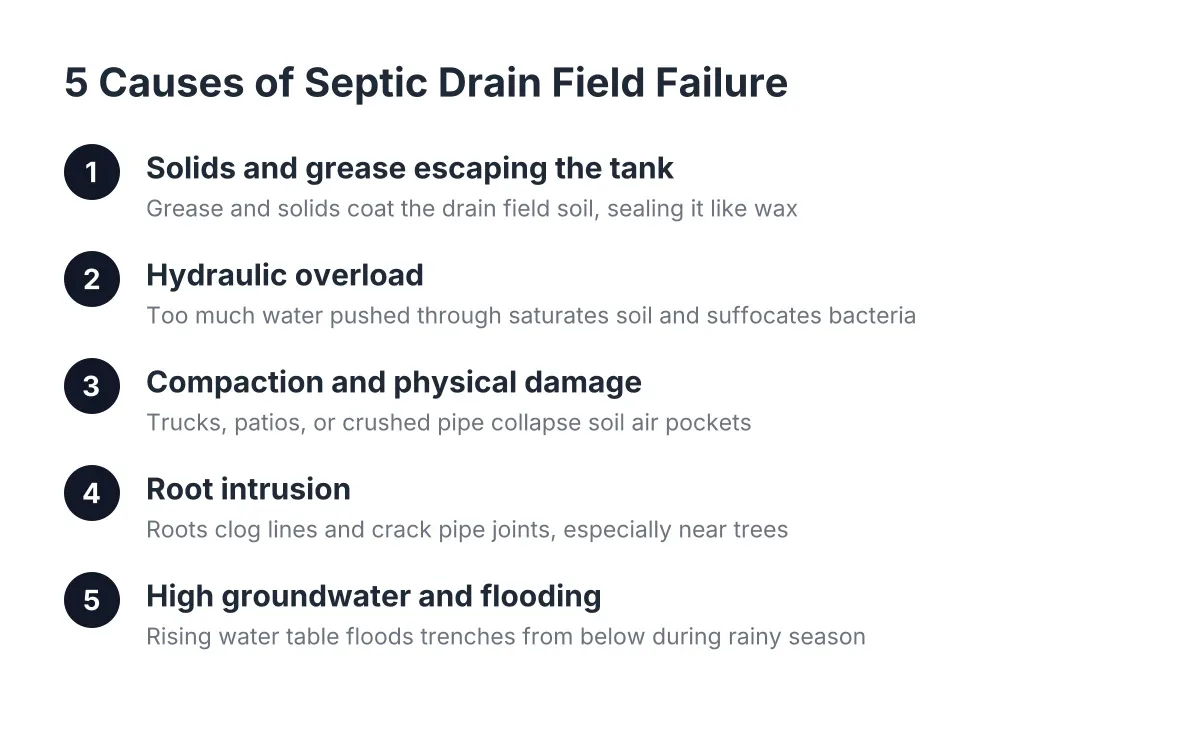
Leach fields fail for a handful of reasons, and the reason determines the fix:
- Solids escaped the tank. When a tank goes too long without a pump out, sludge builds up and flows into the field, clogging the pipe and the soil.
- Biomat overgrowth. A black, tar-like bacterial layer forms in the soil over years of use. Some biomat is normal. Too much seals the soil so water cannot drain.
- Crushed or broken pipe. Vehicles parked over the field, heavy equipment, or tree roots can break leach field pipe without harming the soil around it.
- Soil saturation. Miami's high water table and heavy rainy seasons can flood a field temporarily, making it act failed when it is only overwhelmed.
- Old age. Fields wear out. Soil pores fill in slowly over decades, and eventually the ground simply cannot absorb any more.
Notice that only the last cause is a true death sentence for the field. The first four often have answers short of full leach field replacement.
Signs of Leach Field Failure You Should Not Ignore
Signs of leach field failure include slow drains throughout the building, sewage odors outside, wet or spongy ground over the field, unusually green grass in stripes above the pipe lines, and sewage backing up into the lowest drains. One symptom alone is a warning. Several together mean the field is struggling now.
Watch for these specific signals:
- Slow drains everywhere, not just one fixture. One slow sink is a plumbing clog. Every drain running slow points to the tank or field.
- Standing water or mushy grass over the field, especially when it has not rained recently.
- Sewage smell in the yard near the tank or field area.
- Bright green, fast-growing grass stripes above the leach field lines, fed by wastewater that is surfacing instead of draining down.
- Gurgling sounds in toilets and drains after water use.
- Backups into tubs or floor drains, which usually arrive last and mean the system has nowhere left to send water.
For property managers, tenant complaints are often the first alert. Suppose a tenant in a four-unit building reports a sewage smell near the back lawn. If a second tenant mentions slow drains the same week, treat that as a system-level symptom, not two coincidences. Document the date, get the tank inspected, and you will have a service record that helps with the board, insurance, and any future sale.
Rule One: Pump and Inspect Before You Decide Anything
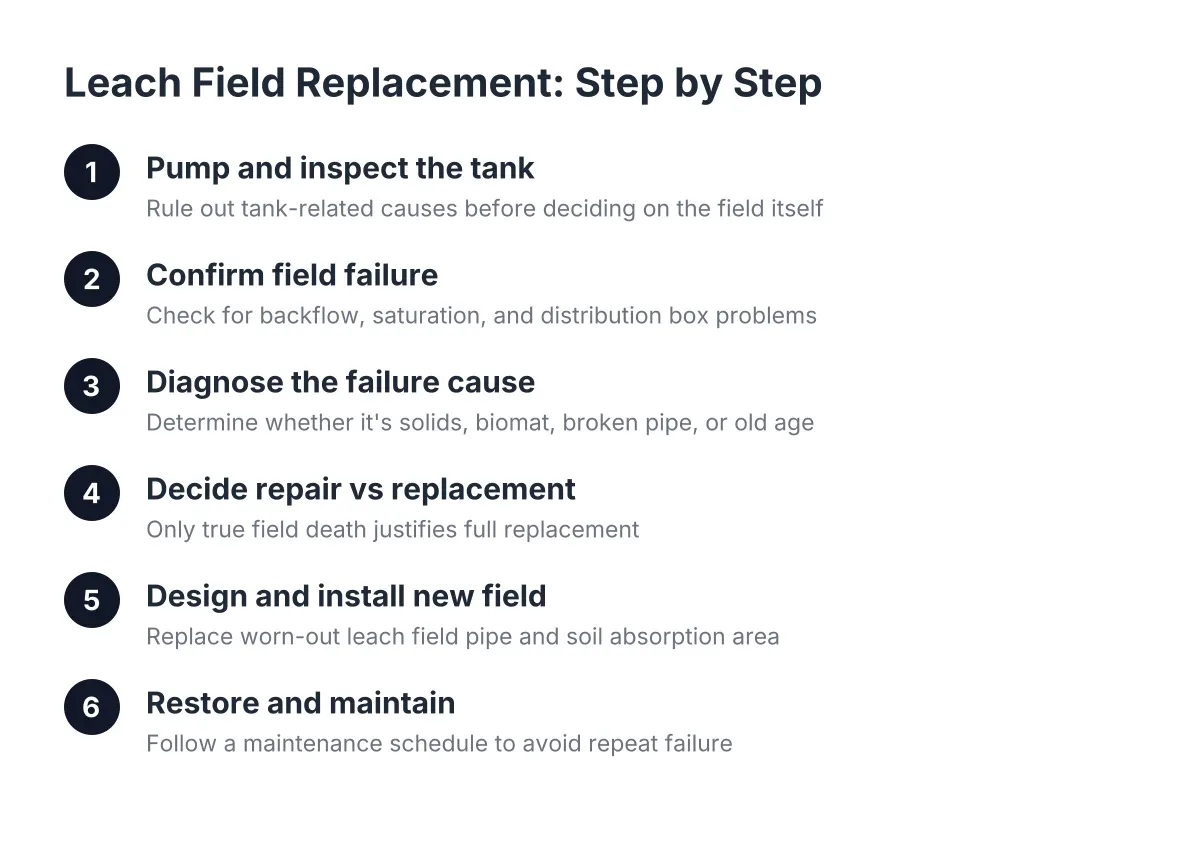
Never agree to leach field replacement based on symptoms alone. The single most useful diagnostic step is a septic tank pumping paired with an inspection. It is also the cheapest step in the entire process, which is exactly why some companies skip past it to the expensive quote.
Here is why pumping first matters. Many "failed field" symptoms are actually tank symptoms. A tank overloaded with sludge pushes solids into the field and backs water up into the house. Once the tank is pumped and the outlet filter is cleaned, a surprising number of systems recover on their own or reveal a much smaller problem.
During the pump out, a good technician checks several things:
- How full the tank was. A tank packed with sludge suggests the field was being force-fed solids, which may be reversible.
- Whether water flows back from the field into the empty tank. Backflow is a strong sign the field is saturated or clogged.
- The condition of the outlet baffle and septic tank filter. A missing baffle or clogged filter lets solids reach the field. Septic tank filter cleaning is a small job that prevents a huge one.
- The distribution box, where clogs or tilting can starve some field lines and flood others.
The U.S. Environmental Protection Agency recommends inspecting the entire septic system every 1 to 3 years and pumping the tank every 3 to 5 years. If your system has not seen either in a decade, do that first. You cannot make a smart repair-versus-replace decision with a tank full of sludge hiding the evidence.
When Leach Field Repair Is the Right Call
Leach field repair makes sense when the failure is partial, mechanical, or caused by problems upstream at the tank. If the soil itself can still absorb water, you can usually fix the specific broken piece instead of digging up the whole field. That is the core distinction: repair fixes a component, replacement rebuilds the soil treatment area.
What is a leach field repair?
A leach field repair replaces or restores one failed part of the drain field while the surrounding soil keeps doing its job: a crushed or root-invaded run of pipe, a clogged or tilted distribution box, or a field that was overloaded by a neglected tank and needs to rest. Replacement, by contrast, rebuilds the whole absorption area. The pump-and-inspect visit above is what tells you which one you actually need.
Situations that typically point toward repair rather than replacement:
- A crushed or root-invaded section of leach field pipe. The damaged run can be excavated and replaced while the rest of the field keeps working.
- A clogged or failed distribution box. Replacing a distribution box is a small excavation job, not a field rebuild.
- Tank neglect that pushed solids into the field. After a thorough septic tank cleaning, reduced water use for several weeks can let a lightly clogged field rest and recover.
- Biomat buildup in an otherwise sound field. Some fields respond to aeration treatments or mechanical soil fracturing that opens compacted soil around the lines. Results vary, and an honest contractor will say so.
- Hydraulic overload. Leaking toilets, a new tenant load, or a laundry-heavy household can drown a field that is otherwise fine. Fix the water volume and the field often bounces back.
There is a real trade-off to weigh. Repairs on an aging field buy time; they do not reset the clock. If your field is 25 years old and showing multiple symptoms, spending on a series of repairs can end up costing more than planning one replacement on your own schedule. A soil evaluation from a qualified septic professional is the only reliable way to know how much life the field has left, and it is worth getting before you commit money in either direction.
When Leach Field Replacement Is the Only Real Fix
Leach field replacement becomes necessary when the soil around the field can no longer absorb and treat wastewater, no matter what you fix upstream. At that point, no amount of pumping, pipe repair, or resting will bring the field back. The soil is the treatment system, and once it seals, the field is done.
The clearest indicators that you are past repair:
- Water flows back into the tank from the field every time it is pumped.
- Symptoms return within days or weeks of a pump out, repeatedly.
- Sewage surfaces over most of the field, not one isolated spot.
- The field has already failed and been rested or treated before, and it failed again.
- A soil evaluation shows the absorption area is saturated with biomat throughout.
Age is the honest backdrop to all of this. With proper maintenance, septic tanks can last up to 30 years, according to University of Florida IFAS, and well-kept drain fields can reach a similar range. A field failing at year 8 probably has a fixable cause. A field failing at year 28 has usually served its term.
If replacement is the verdict, one practical note for Miami-area properties: the new field must meet current health department rules, which may differ from what was installed decades ago. High water tables in South Florida sometimes require mounded or elevated systems. Expect a site evaluation and permitting before any digging starts, and build that lead time into your planning, especially if you are coordinating around tenants.
What Leach Field Replacement Involves, Step by Step
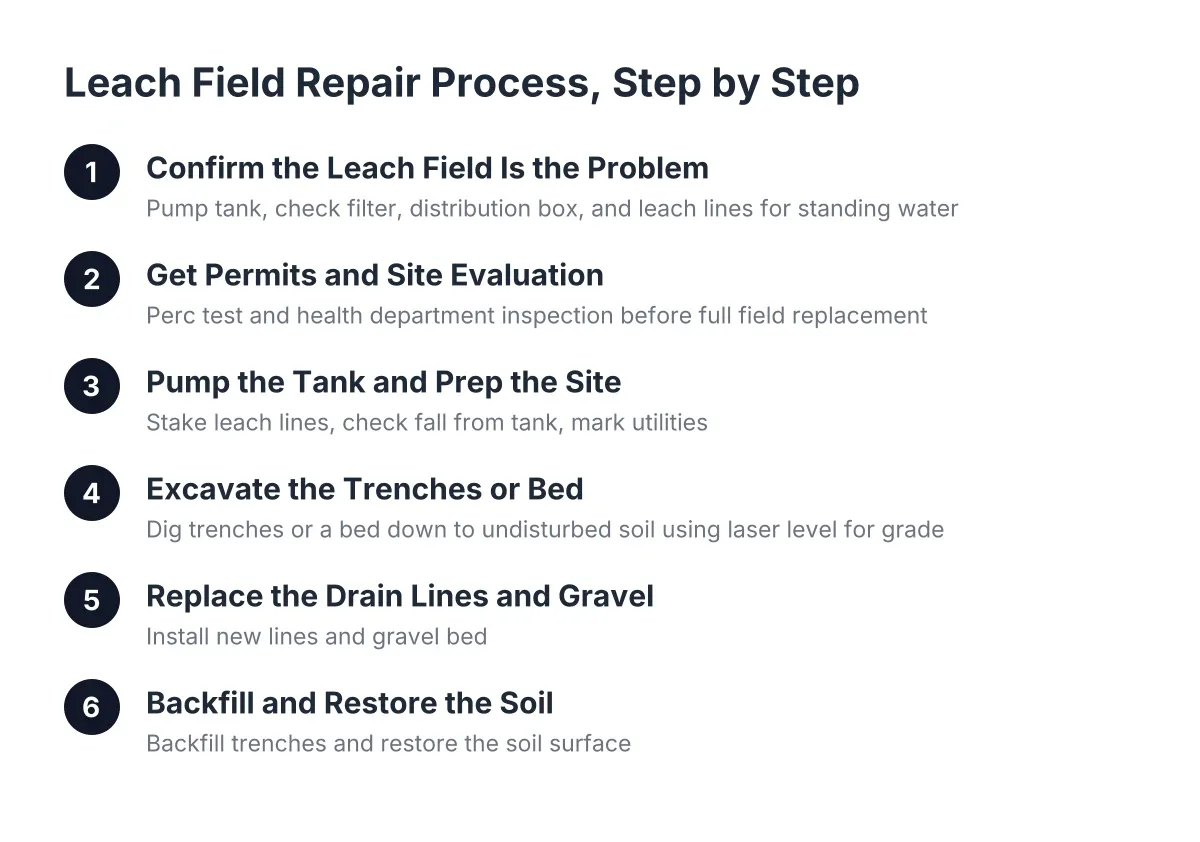
A leach field replacement project follows a predictable sequence: site and soil evaluation, permitting through the local health department, excavation of a new absorption area, installation of new distribution piping and drainage media, connection to the existing tank, inspection, and backfill. Most of the calendar time goes to permitting, not digging.
Knowing the sequence helps you manage it:
- Soil and site evaluation. A professional tests where a new field can legally and physically go.
- Permitting. The local health department reviews the design. Timelines vary by county workload.
- Excavation and installation. Crews dig the new area, lay leach field pipe or chambers, and connect it to the tank or a new distribution box.
- Inspection and backfill. The county inspects the open trenches before they are covered.
- Site restoration. The area is graded and reseeded or sodded.
For a single home, the digging itself often takes days, not weeks. For an HOA or multifamily property, the bigger job is coordination: notifying residents, roping off the work area, and keeping water use low during the switchover.
Repair vs. Replacement: The Cost Logic in Plain Terms
Here is the honest framing on cost, without the "call for a quote" runaround. Repairs are component-priced; you pay for one pipe run, one distribution box, or one treatment. Replacement is system-priced; you pay for design, permits, excavation, materials, and restoration together. The gap between the two is usually large, which is exactly why correct diagnosis matters so much.
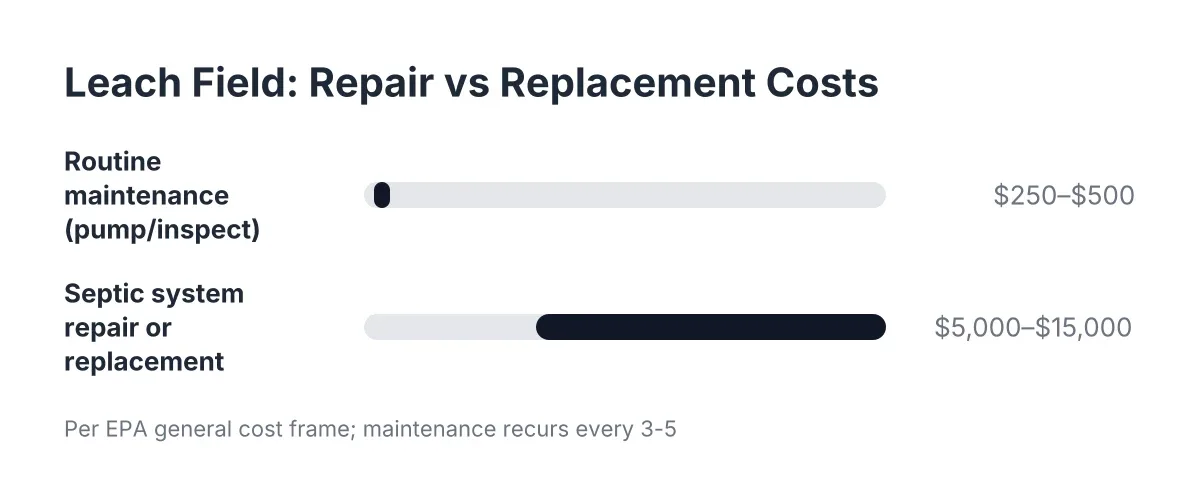
The U.S. Environmental Protection Agency puts the comparison plainly: regular septic maintenance fees of $250 to $500 every three to five years are a bargain compared to repairing or replacing a malfunctioning system, which can cost between $5,000 and $15,000. That is the whole argument for maintenance in two numbers. A routine septic tank maintenance cost is a rounding error next to a septic drain field repair cost, and both are small next to a full rebuild.
Say a homeowner in the Miami area notices soggy ground over one corner of the field. In an illustrative scenario like that, a pump out and inspection might reveal a single crushed pipe run under an old parking spot. Fixing that one run is a modest excavation job. Skipping the inspection and accepting a replacement quote for the same symptom would cost many times more, for a field that mostly still worked.
For property managers running vendor bids, apply the same logic at portfolio scale. Ask every bidder the same three questions: What did the tank inspection show? What specific component failed? Why can that component not be repaired? A bid that jumps straight to full replacement without answering all three deserves a second opinion.
How to Avoid Being Sold a Replacement You Do Not Need
Protecting yourself here does not require septic expertise. It requires a short checklist and the willingness to slow down for a week. Failing leach fields feel urgent, and urgency is where bad decisions happen.
Work through these steps before signing anything:
- Get the tank pumped and inspected first. No one can honestly diagnose a field through a closed tank lid.
- Ask for the evidence. Backflow from the field, distribution box condition, and soil observations should be described to you specifically, not waved at.
- Get a second opinion on any full replacement quote. A few days' delay is nothing against the price difference.
- Ask what repair options were considered and ruled out, and why.
- Request everything in writing, including what was inspected and what was found. Property managers need this for records anyway; homeowners should want it too.
One caution in the other direction. If sewage is backing up into the building or pooling where children or pets play, that is a health issue, and delaying for weeks to shop quotes is the wrong move. Get the tank pumped immediately to relieve pressure on the system, then make the repair-versus-replace decision with the pressure off.
The Maintenance Schedule That Keeps You Out of This Article
Everything above gets easier, or unnecessary, with a boring routine. University of Florida IFAS advises pumping tanks every three to five years to keep them in proper working order, and the EPA pairs that with a full system inspection every 1 to 3 years. Set those dates on a calendar and the odds of ever facing an emergency leach field replacement drop sharply.
A simple plan for a Miami-area property looks like this:
- Pump the tank on a fixed cycle, every three to five years for a typical household, more often for heavy use or multifamily buildings.
- Clean the septic tank filter during every pump out, and between pump outs if drains slow down.
- Keep records. Date, service performed, tank condition, and any notes. For HOAs and property managers, one folder per property turns a liability question into a paperwork answer.
- Protect the field. No parking, no sheds, no heavy landscaping over the lines. Direct roof gutters and drainage away from the area.
- Watch water volume. Fix running toilets fast, and spread laundry across the week instead of stacking it on one day.
If you just bought a home and have no idea when the tank was last serviced, start the clock now with a pump out and inspection. That first visit tells you what shape the tank and field are in, and it establishes the baseline every future decision rests on.
The bottom line is simple. A struggling leach field is not automatically a dead one. Pump first, inspect second, repair what is actually broken, and reserve full leach field replacement for the systems that have genuinely run out of soil and time. That order of operations is how you keep the scariest septic repair from becoming your septic repair.
If you need septic tank pumping, Miami Septic Tanks can help.
Prefer to talk it through? Call (786) 756-8032 — a quick call is usually the fastest way to get a straight answer for your situation.