How Often to Pump a Septic Tank: A Frequency Schedule for Miami Homeowners
If you own a home on septic in the Miami area, one question matters more than any other: how often should the tank be pumped? Getting your pump septic tank frequency right is the difference between a routine service call every few years and a leach field failure that costs thousands. This guide lays out a realistic schedule, the factors that change it, and what actually happens during a pump out, with straight answers and no upsell tactics.
That last part matters. Search for a septic pumper online and you will find national aggregator sites that route your call out of state, plus thin local pages that rank on old content and say nothing useful. Neither will tell you the plain truth, which is this: most tanks need pumping every three to five years, some need it more often, and the schedule depends on facts about your household you can figure out yourself.
Why Pump Septic Tank Frequency Matters More Than Homeowners Think
Your septic system is simple at its core. According to the US EPA, a single pipe carries all your household drains to the septic tank, where solids settle out. The remaining liquid flows out through perforated pipes into the drain field, also called the leach field, where the soil finishes the job.
Here is the catch. Those solids never leave on their own. They sit at the bottom of the tank and build up, year after year, until someone pumps them out. A pump truck removes them and hauls the waste to a treatment plant for disposal; according to the New Hampshire Department of Environmental Services, that is how residential septic waste is handled everywhere, since none of it gets processed on site.
Skip the pump out long enough and the solids rise high enough to flow out with the liquid. Once solids reach the leach field, they clog the soil. At that point you are no longer talking about a service call. You are talking about leach field repair or replacement, which is one of the most expensive problems a homeowner on septic can face.
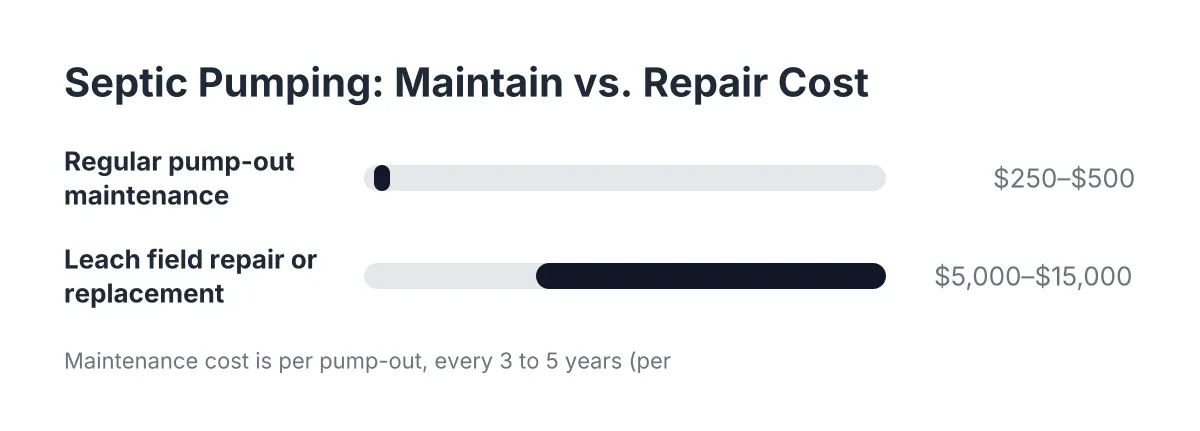
The math is lopsided. According to the U.S. Environmental Protection Agency, regular maintenance runs about $250 to $500 every three to five years, while repairing or replacing a failed system can cost $5,000 to $15,000. Few home maintenance decisions have a payoff that clear.
This is a local problem at scale, too. Miami Waterkeeper reports about 120,000 septic systems in Miami-Dade County, and University of Florida IFAS notes that about 2 million Florida homes, about 30% of the state's residents, rely on septic. If you are on an older estate lot in Coral Gables, Coconut Grove, or Key Biscayne, odds are good your home is one of them.
The Baseline Schedule: Every 3 to 5 Years
For a typical single-family home, plan on pumping every three to five years. The U.S. Environmental Protection Agency recommends inspecting the entire septic system every 1 to 3 years and pumping the tank every 3 to 5 years. University of Florida IFAS gives the same three-to-five-year pumping guidance for Florida homes and adds that a well-maintained tank can last up to 30 years.
Think of it like an oil change with a much longer interval. You do not wait for the engine to seize before changing the oil, and you should not wait for a backup before scheduling a pump out. A tank that has never given you trouble still fills with solids on schedule; the absence of symptoms only means the problems have not surfaced yet.
However, three to five years is a range, not a rule. Your actual pump septic tank frequency depends on a handful of factors specific to your house, and that is where the generic advice online falls short.
What Changes Your Pump Septic Tank Frequency
Four things drive how fast a tank fills with solids. Weigh each one against the baseline and you will land on a schedule that fits your home instead of an average home.
How many people live in the house
More people means more wastewater and more solids. According to Penn State Extension, an active family of four should generally pump every two to three years because of the higher volume the household produces. A retired couple in the same house could often stretch to five years. If your household grew, say adult kids moved back in or you added a rental suite, shorten the interval.
How big the tank is
Tank size sets the buffer. A common 1000 gallon septic tank serving a family of four fills faster than a 1500 gallon tank serving the same family, so its pump frequency should be shorter. Many Miami-area homes built before 2000 have smaller tanks than a builder would install today. If you do not know your tank size, it should be on your county records or the report from your last pump out, and any local crew can measure it during service.
What goes down the drains
Households that treat the toilet like a trash can pump more often. Wipes, even the ones labeled flushable, along with grease, paper towels, and heavy garbage disposal use, all add solids the bacteria in the tank cannot break down. In addition, harsh drain cleaners kill the bacteria that digest waste, which slows the whole system down. Careful households can extend the interval; careless ones shorten it.
Whether local rules set a minimum
Some localities require pump outs at set intervals regardless of the tank's condition. Before you settle on a schedule, check what Miami-Dade County requires for your property, especially if you are near sensitive waterways. Florida's environmental and health agency sites also publish pump-out guidance and contractor directories, which are worth a look.
A Practical Frequency Chart by Household
Here is a simple way to translate those factors into a working schedule. Treat these as planning estimates, not measurements; the only way to know for sure is to have someone open the lid and check the sludge level.
- 1 to 2 people, average water use: every 4 to 5 years
- Family of 4, typical use: every 2 to 3 years
- 5 or more people, or heavy disposal use: every 1 to 2 years
- Vacation home or little-used property: inspect every 3 years, pump when the check shows it is needed
- Home with a garbage disposal used daily: move one bracket shorter than your household size suggests
Notice that how often to pump a septic tank for a family of 4 lands at the short end of the standard range. That surprises people. The three-to-five-year figure gets quoted so often that a busy four-person household assumes it applies to them, then wonders why the drains slowed down in year four.
One honest caveat: a little-used tank is not a maintenance-free tank. Solids still accumulate slowly, and gases and corrosion still need checking. Even a lightly used system benefits from an inspection every few years, and a professional should make the call on skipping a pump out, not the calendar alone.
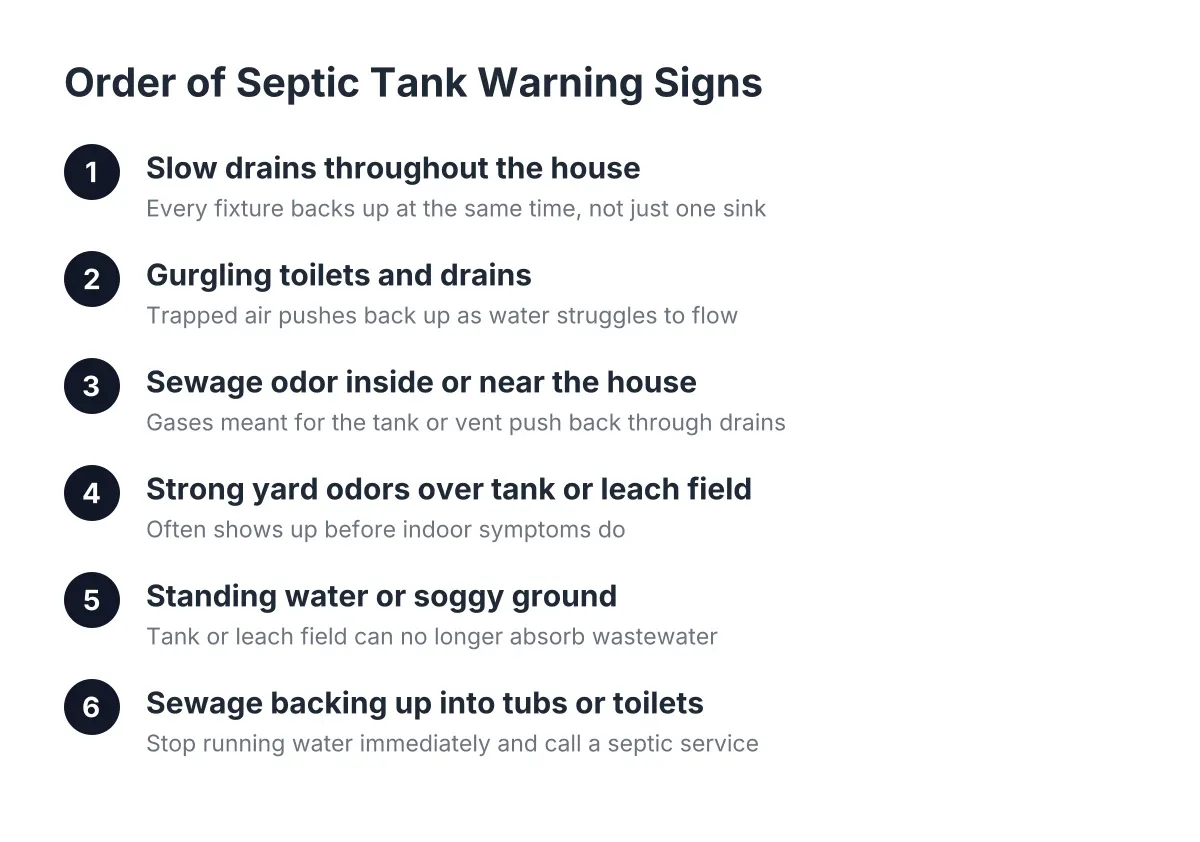
Signs You Waited Too Long
A schedule keeps you ahead of trouble, but if you inherited a tank with no records, watch for these warnings. Any one of them means the tank is due now, not next year.
- Drains throughout the house run slow at the same time, not just one fixture
- Sewage odor in the yard, near the tank lids, or inside the house
- Wet, spongy, or unusually green patches of grass over the leach field
- Gurgling sounds from toilets or drains
- Sewage backing up into the lowest drains in the home
Therefore, treat symptoms as a failure of the schedule, not a substitute for one. By the time you can see or smell a problem, solids may already be reaching the leach field. Symptoms show up after damage starts, which is exactly why a regular pump septic tank frequency beats waiting for a sign.
South Florida adds one more trigger. After major flooding or a storm surge, a septic system that went underwater needs professional attention; University of Florida IFAS notes that flooded systems must be professionally cleaned. Do not just wait for the yard to dry out and hope.
What Happens During a Pump Out
Knowing the process removes most of the anxiety, especially if you have never scheduled one. A routine residential septic tank pumping visit follows the same basic steps everywhere.
- Locate and open the tank. The crew finds the lids, digs them up if they are buried, and opens the tank. If you know where your lids are, the visit goes faster.
- Check the levels. Before pumping, a good crew looks at the sludge and scum layers. This tells you whether your current schedule fits your household or needs adjusting.
- Pump the tank. A vacuum hose from the truck removes solids and liquid. For a typical residential tank, expect the whole visit to take about an hour, sometimes less.
- Look things over. With the tank empty, the crew can spot cracks, root intrusion, corrosion, and problems with the inlet and outlet baffles. The outlet matters; as the University of Nebraska-Lincoln Extension explains, the outlet must sit lower than the inlet so only liquid, not floating solids, exits toward the drain field.
- Clean the filter if the tank has one. Many tanks have an outlet filter that catches solids before they reach the leach field. Septic tank filter cleaning at each pump out keeps that protection working.
- Haul the waste away. Everything pumped out goes by truck to a treatment plant.
For example, suppose a homeowner in Coconut Grove with a pre-1990 house and a family of four has not pumped in six years. In that scenario, a typical crew would expect a heavy sludge layer, would recommend moving to a two-to-three-year schedule going forward, and would check the outlet baffle carefully, since a tank that full often pushes solids toward the leach field. The pump out itself would still be a normal, one-visit job if the field has not clogged yet.
Buying or Selling a Home on Septic? The Schedule Is Your Paper Trail
If you are in the middle of a home sale and an inspector just flagged the septic system, take a breath. A flagged system is not automatically a failed system. Often the finding is simply that the tank is full or there is no service history, and a pump out plus an inspection resolves it.
Here is what buyers, sellers, and their agents should know about septic and closings:
- Sellers: a recent pump out with documentation answers the most common inspection question before it gets asked. If your tank has not been pumped in five or more years, doing it before listing removes a bargaining chip from the buyer's side.
- Buyers: ask for pump-out records. A tank pumped on a regular three-to-five-year cycle tells you the system was cared for. No records at all means budget for a pump out and inspection right after closing, and consider making a septic system inspection part of your contract.
- Both sides: a pump out and an inspection are different services. Pumping empties the tank; an inspection evaluates the tank, baffles, and leach field. For a real estate deal, you usually want both, and the tank often needs to be pumped so the inspector can see its condition.
However, know the limits of what a pumping visit can tell you. If the inspection turns up a compromised leach field, a cracked tank, or a failed pump, you need a diagnosis and repair plan, not just an empty tank. Cost of septic pump replacement, when a system uses an effluent pump and it fails, is a repair conversation separate from routine pumping, and leach field repair even more so. Those situations call for a professional evaluation before anyone signs anything.
What This Costs, and Why the Cheapest Quote Deserves a Second Look
Homeowners searching for the cheapest septic tank pumping should keep the EPA's maintenance range in mind: about $250 to $500 every three to five years for regular service, according to the U.S. Environmental Protection Agency. Your septic pump cost will vary with tank size, how deep the lids are buried, and how long since the last service. That range is the anchor for judging quotes.
Be careful with prices that sound too good. A common bait tactic is a low advertised price that covers only partial pumping or excludes basics like digging up the lids, with the real number appearing once the truck is in your driveway. A trustworthy local operator quotes the realistic price up front and explains what changes it.
The same skepticism applies to who answers the phone. National lead-gen sites take your call in another state, sell your information, and treat Miami like every other metro. As a result, you get whoever paid for the lead, not whoever knows the area. A local septic pump out company that works Miami-area streets knows the older neighborhoods on septic, the county's rules, and what South Florida's water table does to these systems.
Putting Your Pump Septic Tank Frequency on the Calendar
Here is the whole guide compressed into a plan you can act on in 2026:
- Find your last pump-out date. Check receipts, county records, or ask the previous owner.
- Count your household and note your tank size if you know it.
- Set your interval: two to three years for a full house, three to five for a smaller one.
- Put the next pump out on your calendar now, before symptoms make the decision for you.
- At each service, ask the crew to check sludge levels and the outlet filter, then adjust the interval based on what they find.
- If you are buying or selling, get the pump out and inspection done early in the process, not the week of closing.
The most reliable way to know when your tank needs pumping is not watching for signs. It is a regular schedule, checked and adjusted by someone who opens the lid every few years. Regular pumping is the single most effective thing you can do to extend the life of the system, and on a home that may depend on it for another decade or more, that is worth a calendar reminder.
If you need septic tank pumping, Miami Septic Tanks can help.
Prefer to talk it through? Call (786) 756-8032 — a quick call is usually the fastest way to get a straight answer for your situation.