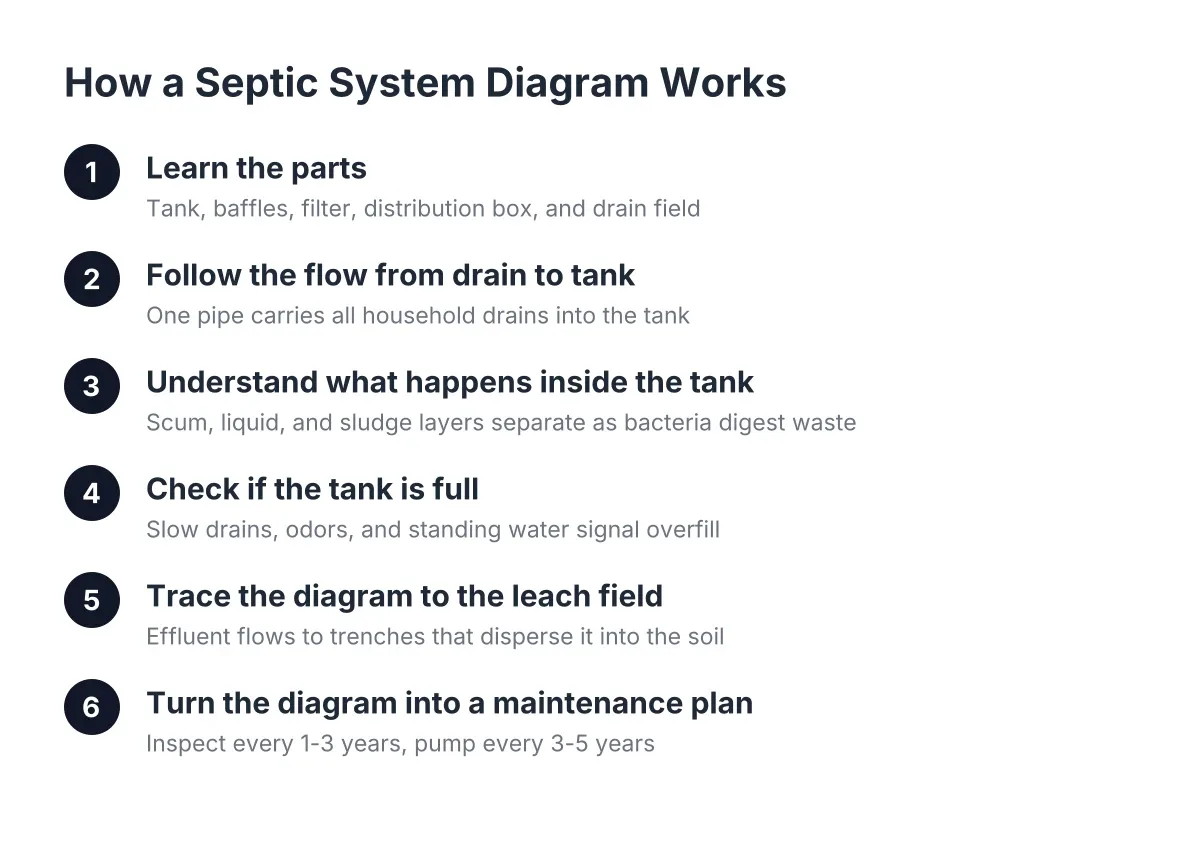
Septic System Diagram Explained: How Your Tank and Drain Field Work
If sewage is backing up into your tub, or a tenant just called you about a smell in the yard, the fastest way to understand what is happening is a septic system diagram. It shows where your wastewater goes, where things clog, and why. This guide walks you through that diagram step by step, in plain language, so you can tell whether you have a plumbing problem, a full tank, or a failing leach field before you make a single call.
You do not need to be an expert. You just need to know the parts, the order water moves through them, and what each part looks like when it fails. That is what the steps below cover, from the drain pipe in your house to the soil at the end of the line.
Step 1: Learn the Parts on a Septic System Diagram
Start by naming the pieces. Every basic septic system diagram shows the same core parts, and knowing them turns a confusing emergency into a checklist.
According to the US EPA, a typical residential septic system has two main components: a tank that clarifies wastewater and a drain field that disperses the clarified liquid into the ground. Everything else supports those two jobs.
Here is what you will see on most diagrams, in the order wastewater reaches them:
- Main drain line: A single pipe that carries everything from your toilets, sinks, showers, and laundry out of the building.
- Septic tank: A buried, watertight tank, often concrete, where solids settle and bacteria start breaking down waste. Shapes vary by region; some areas use rectangular concrete tanks and others use round ones, according to the International Code Council.
- Inlet and outlet baffles: Downward-facing tees inside the tank that keep solids from floating straight through.
- Outlet filter: A screen on the outlet, on many modern tanks, that catches solids before they reach the drain field. This is what septic tank filter cleaning maintains.
- Distribution box: A small box that splits the flow evenly among the drain field pipes. Diagrams with a distribution box show it between the tank and the field.
- Drain field (leach field): Perforated pipes laid in gravel trenches where the liquid soaks into the soil for final treatment.
Some properties add a pump. A septic system diagram with a pump includes a separate pump chamber that lifts wastewater uphill to the drain field when gravity cannot do the work. If your property sits low or the field sits far from the tank, you likely have one.
Step 2: Follow the Flow From Drain to Tank
Next, trace the water. Understanding the flow is the single most useful thing a diagram teaches, because it tells you where a backup is coming from.
According to the US EPA, a single pipe connects all household drains to the septic tank. Inside the tank, three layers form. Grease and oils float to the top as scum. Heavier solids sink to the bottom as sludge. The middle layer is liquid, and only that liquid should leave the tank.
The baffles make this work. According to University of Nebraska-Lincoln Extension, septic tanks use a baffle at both the inlet and outlet that stops solids from floating to the top and forces them to settle. The same source notes the outlet pipe must sit lower than the inlet, since solids float and only liquid should exit toward the drain field.
Here is why this matters when your toilet backs up. If one fixture drains slowly but the others work, the clog is probably in your house plumbing; call a plumber. If every drain in the house backs up at once, the problem is likely at the tank or beyond, and a septic company should look first. Knowing that one distinction can save you from paying two service calls for one problem.
Step 3: Understand What Happens Inside the Tank
The tank is not just a holding box. It is a living system. Anaerobic bacteria digest the organic waste, shrinking the sludge layer over time. This is basic biology, and it happens without additives. That is worth knowing, because products that promise to replace pumping do not remove the sludge that keeps building up.
However, bacteria only slow the buildup. They never stop it. Sludge and scum grow until they crowd out the liquid layer, and that is when trouble starts. Solids get pushed into the outlet, clog the filter, or worse, wash into the drain field where they plug the soil for good.
Which raises the question most homeowners ask in a panic.
How Do I Know if My Septic Tank Is Full? Reading Your System Diagram
A septic tank is full when the sludge and scum layers take up so much space that solids can escape into the outlet or back up the inlet. Warning signs include slow drains throughout the house, gurgling pipes, sewage odors inside or near the tank, wet or lush grass over the drain field, and standing water in the yard.
The catch is that these signs show up late. By the time sewage reaches your shower drain, the tank has usually been overfull for a while. That is why the U.S. Environmental Protection Agency recommends inspecting the entire septic system every 1 to 3 years and pumping the tank every 3 to 5 years, before symptoms appear.
For example, suppose a property manager oversees a 12-unit complex in the Miami area on septic. One tenant reports a sewer smell, and the manager has no service records to check. In that scenario, the first practical move is a septic system inspection and pump out, which establishes a baseline and produces documentation for the file. From there, the whole portfolio can go on a rotating pumping schedule instead of waiting for the next 2 a.m. complaint.
Step 4: Trace the Diagram Out to the Leach Field
After the tank, the liquid, called effluent, flows to the drain field. On a septic system diagram, the leach field appears as a set of parallel trenches fanning out from the distribution box.
According to the U.S. Environmental Protection Agency, wastewater is distributed through perforated lateral pipes into the drain field, then filtered through gravel or stone and finally through sand and soil. The soil does the real treatment. Microbes in the ground remove bacteria and many contaminants before the water rejoins the groundwater below.
This last step matters more in Florida than most places. According to the Florida Department of Environmental Protection, proper design, construction, and maintenance of septic systems help protect Florida's groundwater, which provides 90% of the state's drinking water. A failed leach field is not just a soggy yard; it is a direct line to the water everyone drinks.
One honest limitation: even a healthy system is not a perfect filter. According to University of Florida IFAS, a conventional septic tank removes only about 30 percent of the nitrogen that flows into it. Some Miami-area properties near sensitive waters use aerobic treatment units (ATUs) instead, which add an aeration chamber to treat wastewater further before it reaches the soil. If you are comparing septic tank types for a purchase or replacement, that difference is worth asking about.
Step 5: Compare Septic to City Sewer Before You Decide Anything
If you are new to septic, here is the core difference. On city sewer, your wastewater leaves the property and becomes the utility's problem. On septic, treatment happens in your yard, and maintenance is on you. There is no monthly sewer bill, but there is also no one else watching the system.
The trade-offs cut both ways:
- Sewer: Predictable monthly cost, no pumping, but no control over rate increases, and connection is not available on many Miami-area streets.
- Septic: No monthly bill and, according to University of Florida IFAS, tanks can last up to 30 years with proper maintenance. The catch is that neglect gets expensive fast.
On cost, the math favors maintenance. According to the U.S. Environmental Protection Agency, regular maintenance fees of $250 to $500 every three to five years are a bargain compared to repairing or replacing a failed system, which can cost between $5,000 and $15,000. When people search septic tank cost in a panic, it is usually because they skipped the small bill and got the big one.
Step 6: Turn the Diagram Into a Maintenance Plan
Finally, put the picture to work. Once you can read a septic system diagram, maintenance stops being mysterious. It becomes a short list tied to specific parts:
- Pump the tank every 3 to 5 years. A pump out removes the sludge and scum before they reach the drain field. The waste is trucked to a sewage treatment plant for disposal, according to the New Hampshire Department of Environmental Services; nothing stays on your property.
- Clean the outlet filter about once a year. Septic tank filter cleaning is quick, and a clogged filter is one of the most common causes of a sudden whole-house backup.
- Inspect every 1 to 3 years. An inspection checks baffles, the distribution box, and the leach field before small problems become excavation projects.
- Add grease trap clean out for commercial kitchens. Restaurants and multifamily properties with shared kitchens send far more grease into the system, and grease is what kills drain fields early.
For a property manager, the same list scales across a portfolio. Rotating pump outs and inspections through a single local Miami-area vendor produces a documented service history, which matters for insurance, pre-sale inspections, and tenant disputes. For a homeowner, it means never again typing septic cleaner near me at midnight with water rising in the tub.
If you want to go deeper on the vocabulary before comparing septic pump out companies, our plain-English glossary covers the rest of the septic tank basics, from baffles to distribution boxes.
One caution to close on. A diagram helps you narrow down a problem, but it cannot tell you whether your leach field is saturated or your tank has a cracked baffle. If sewage is actively backing up, or the yard over the field stays wet, stop guessing and get a professional to open the tank and look. Diagnosing from above ground is how small repairs turn into leach field repair.
If you need septic tank pumping, Miami Septic Tanks can help.
Prefer to talk it through? Call (786) 756-8032 — a quick call is usually the fastest way to get a straight answer for your situation.