Septic Tank vs. Municipal Sewer: Which System Serves Your Miami Home?
If your toilet just backed up, or you bought a home and have no idea what happens after you flush, this is the plain-language answer. Every Miami property handles wastewater one of two ways: a septic tank or municipal sewer service, and understanding the differences when deciding between septic vs. sewer in Miami is key to managing your system effectively. Knowing which one you have changes everything, including who you call when sewage comes up through the drain, what maintenance you owe the system, and what a fix might cost. This guide compares septic tank and municipal sewer setups side by side, in everyday terms, so you can act with confidence instead of guessing.
This matters more in Miami than in most places. According to Miami Waterkeeper, there are about 120,000 septic systems in Miami-Dade County across residential and commercial areas. Statewide, the Florida Department of Environmental Protection reports that about one-third of Florida's population uses septic tanks for wastewater treatment. Odds are decent that your home, or the restaurant space you lease, sits on one.
How Septic and Sewer Systems in Miami Work
A septic tank treats wastewater on your property, while a municipal sewer carries it away to a central treatment plant. That is the whole difference in one sentence. With septic, you own the treatment system. With sewer, the county owns it and you pay a monthly bill for the service.
The septic side: your own small treatment system
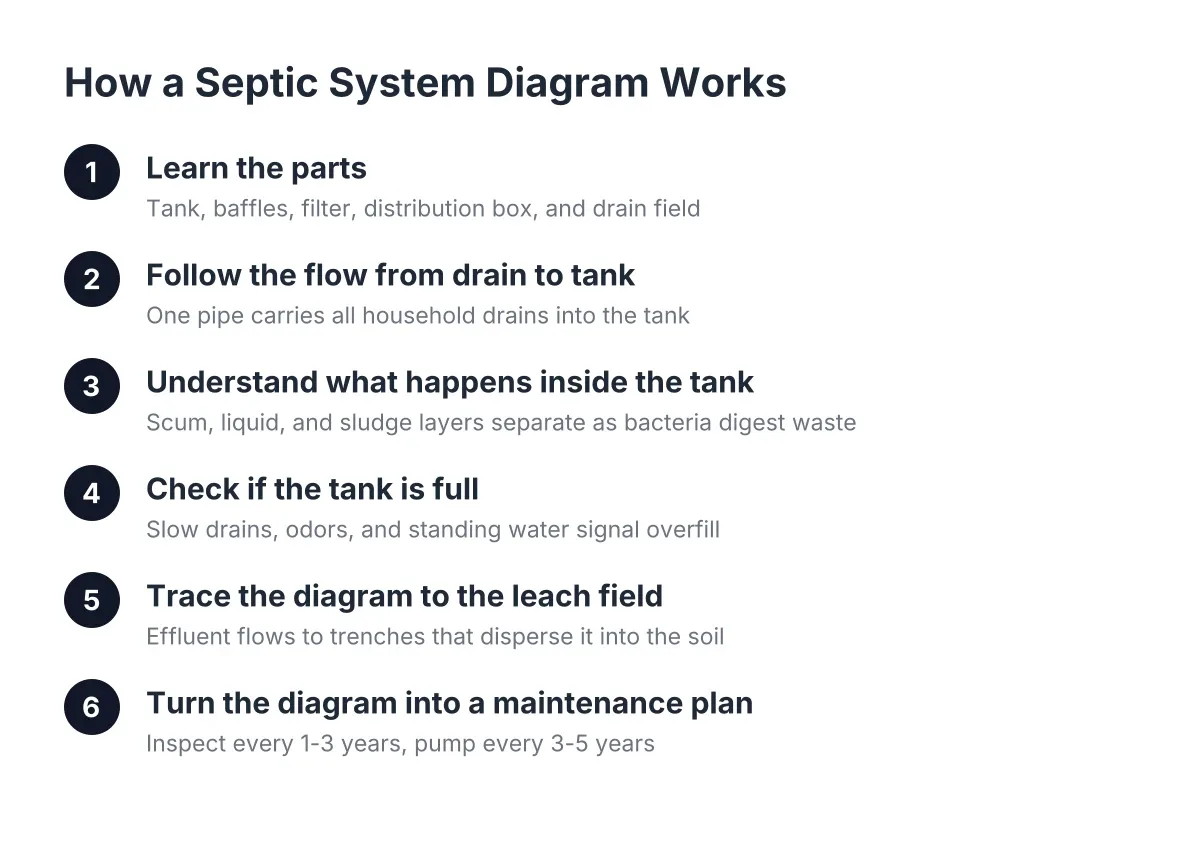
With a septic system, a single pipe connects all your household drains to a buried tank in your yard, according to the US EPA. Solids settle to the bottom of the tank. The liquid that remains flows out through perforated pipes into a drain field, sometimes called a leach field, where soil filters it naturally.
The tank itself is a large watertight container, often concrete, sometimes plastic. A standard 1000 gallon septic tank is common for a three-bedroom home, though sizes vary. Inside, bacteria break down waste over time. The tank forms layers: a scum layer on top, clear liquid in the middle, and sludge on the bottom. Baffles at the inlet and outlet keep solids from escaping into the drain field, a design the University of Nebraska-Lincoln Extension credits with making the whole system work better.
Those solids never leave on their own. That is why septic tank pumping exists. A pump out truck removes the sludge and scum every few years, then hauls it to a treatment plant. According to the New Hampshire Department of Environmental Services, pumped septic waste goes by truck to a sewage treatment plant rather than being processed on site. So even septic waste ends up at the same place city sewage does; it just takes a truck instead of a pipe.
The sewer side: a pipe to the county plant
With municipal sewer, your drains connect to a lateral line that joins the county's underground network. Everything flows to a central treatment plant. Homes in dense city areas typically connect directly to municipal treatment systems and do not use septic tanks at all, according to the Environmental Finance Center Network.
You do not maintain the treatment side. You pay a sewer charge on your water bill, and the county handles the rest. Your responsibility ends at your lateral line, the pipe running from your house to the street.
Septic Tank or Municipal Sewer: Comparing What Each Costs You
A septic tank costs less month to month but puts repair risk on you, while municipal sewer costs a steady monthly fee and shifts big-failure risk to the county. That is the core financial trade-off, and it shapes every other comparison below.
Routine costs
On septic, there is no monthly sewer bill. A common question is, do you pay for sewage if you have a septic tank? No, not as a utility charge. Instead, you pay for periodic septic tank pumping and cleaning, usually every three to five years for a typical household. You may also pay for septic tank filter cleaning if your tank has an outlet filter, plus an occasional septic system inspection.
On sewer, you pay every month whether you use a little water or a lot. Over a decade, those bills add up to more than routine pump outs for most homes. In that narrow sense, septic wins on running cost.
Repair and failure costs
Here the picture flips. A failed leach field, a cracked concrete septic tank, or a collapsed line is your bill alone on septic. There is no utility to absorb it. On municipal sewer, a main line failure in the street is the county's problem; you only own repairs to your own lateral.
Neither side is spotless, though. Miami-Dade County's sanitary sewer system is under a Federal Court Order to correct existing problems and reduce or eliminate releases of untreated sewage into the environment, according to Miami-Dade County. Central systems fail too. The difference is who pays when they do.
Day-to-Day Life: What Changes Depending on Your System
The daily experience differs more than most homeowners expect. Septic asks you to think about what goes down the drain. Sewer mostly does not.
On septic, you should:
- Keep grease, wipes, coffee grounds, and harsh chemicals out of the drains, since the tank is a living system that relies on bacteria
- Avoid parking or building over the tank and leach field
- Watch for early warning signs like slow drains, gurgling, or wet spots in the yard
- Schedule septic tank pumping before the tank fills, not after a backup
- Know where your tank lid is, so a crew is not hunting for it during a problem
On sewer, none of that applies in the same way. Municipal treatment plants handle whatever reasonable household waste arrives. You still should not flush wipes, but a mistake will not poison a bacterial ecosystem in your yard.
There is a real payoff to septic care beyond avoiding backups. Proper design, construction, and maintenance of septic systems help protect Florida's groundwater, which provides 90% of the state's drinking water, according to the Florida Department of Environmental Protection. In Miami, where the water table sits high, that is not an abstract point.
When Sewage Backs Up: Septic vs. Sewer Emergencies
A backup on a septic system usually means a full tank, a clogged filter, or a saturated drain field; a backup on municipal sewer usually means a blocked lateral or a main line problem. Knowing which system you have tells you whether to call a septic pump out company or a plumber first.
Suppose a homeowner in Westchester wakes up to sewage rising in the shower drain. If the house is on septic and the tank has not been pumped in eight years, the most likely fix is an emergency-style septic pump out to relieve the system, followed by a filter cleaning and an inspection of the leach field. If the same house were on county sewer, the first call would be a plumber with a drain snake or camera, because the blockage is almost certainly in the lateral line.
Here is a fast way to tell which system you have:
- Check your water bill. A sewer charge means you are on municipal sewer.
- Look for tank lids or a cleanout cluster in the yard, often two round or rectangular covers.
- Check your property records or the original inspection report from when you bought the home.
- Ask a neighbor. Whole streets in Miami-Dade tend to be on the same system.
One honest caveat: if sewage is actively backing up and you cannot tell which system you have, do not run more water while you figure it out. A misdiagnosis wastes hours. When the cause is unclear, a septic system inspection or a plumber's camera line check settles the question, and this is a situation where a professional is worth the call rather than trial and error.
What Restaurant and Food Service Operators Need to Know
Commercial kitchens face this comparison with an extra layer: grease. Whether the building sits on septic or municipal sewer, a restaurant with fryers and grills almost always has a grease trap, and that trap needs a regular grease trap clean out on a compliance schedule.
The system type still matters, though. Say a small cafe group runs one location in Coral Gables on county sewer and one in a septic-served pocket farther out. The sewer location worries mainly about grease trap cleaning before inspection cycles. The septic location has to manage both the grease trap and the septic tank, because grease that slips past the trap can smother the bacteria in the tank and clog the leach field. As a result, the septic-served kitchen usually needs a tighter pumping schedule and closer attention to what goes down the floor drains.
For operators, the practical move is the same either way: put grease trap clean out and any septic pump outs on a recurring calendar tied to your inspection cycle, so compliance never depends on someone remembering.
Converting Between Septic and Sewer Systems in Miami Properties
Yes, some Miami-area properties can convert from septic to sewer when a county line reaches their street, but the connection cost falls on the property owner and lines have not reached every neighborhood. Septic tank to city sewer cost varies widely by distance to the main, permitting, and site work, so get local numbers before assuming either answer.
Until sewer service reaches a property, septic is not a choice; it is the only option. That is the basic decision rule: where the municipal line does not run, or extending it is out of reach financially, the septic system is the alternative. Plenty of well-kept Miami homes have run on the same concrete tank for decades. How long do septic tanks last? A concrete tank can serve 40 years or more with regular pumping, while a neglected one can fail far sooner. Maintenance, not the material alone, decides the lifespan.
There is also a resale angle worth knowing. Buyers in dense markets often see sewer-connected homes as lower risk, which can affect price. That does not make septic a bad system; it makes documented maintenance records more valuable when you sell.
How to Choose, or How to Live With What You Have
Most Miami homeowners do not get to choose between a septic tank and municipal sewer; the street decides. So the real question is how to succeed with the system you have.
If you are on municipal sewer, your job is short: pay the bill, keep wipes and grease out of the drains, and know where your lateral cleanout is.
If you are on septic, your job is a routine, not a burden. Learn the septic tank basics, find your tank location, and get on a pumping schedule of every three to five years, adjusted for household size. Add septic tank filter cleaning if your system has an outlet filter, and book an inspection if you notice slow drains or odors. Searching for a septic tank near me service is the wrong moment to start learning your system; the right moment is now, while everything still flushes.
Both systems end at the same place, a treatment plant. The difference is whether a pipe takes it there every day, or a local pump out truck takes it there every few years. Know which one you have, keep up your end, and the system will stay out of your way.
If you need septic tank pumping, Miami Septic Tanks can help.
Prefer to talk it through? Call (786) 756-8032 — a quick call is usually the fastest way to get a straight answer for your situation.